
Staircase Feng Shui: Where to Put One, and How to Fix a Bad One
A client opened her front door and the staircase hit her straight in the face. “Guests see straight up to my bedroom,” she said, “and the place never feels like it settles.” She’d lived with it for years and was convinced she just wasn’t a tidy person. She was tidy. The stair was the problem, and once we slowed it, the whole entry relaxed. I’m the founder of FengShuiPower, and since most of my consults are online now, I’ve seen this exact issue through photos and floor plans more times than I can count.
Here’s the thing about stairs that people miss: a staircase is the busiest path in a home. It carries movement between floors the same way a hallway carries it between rooms, so where it sits decides whether energy settles into your living space or shoots past it. There are really only three things I check first, and almost everything else is a variation on them.
The three things I check first
Keep the stair off the line of the front door. Keep it out of the middle of the home. And if you’re picking a design, a curved or L-shaped run beats one long straight flight. Get those three right and you’ve covered most of the staircase questions people put to me.
Two of those are about where the stair sits. The third is about its shape. A straight flight is a slide: energy goes up and doesn’t stop. A turn, even a small landing, gives it a reason to pause. A turn works in a small place too. Even a half-turn before the top step changes how the stair reads.
A stair that hits the front door
This is the complaint I hear most, and the client at the top of this page is the textbook version. The front door is where fresh energy enters. When a staircase sits in a straight line with that door, the eye gets pulled up and away the second you walk in, so the entry never gets a chance to settle. An open stair at the threshold also means anyone at the door sees into the private part of the home. Warm air and sound rush up and out instead of circulating. That last part is a real comfort problem, not a belief, and it’s why older texts flagged a stair at the threshold.
The fix is almost never a remodel. What I tell clients is to break the sightline with something that has weight: a console table, a slender screen, or a healthy plant set just inside the door. It doesn’t close off the walkway. It just slows the eye down. A stair that turns away from the entrance, or sits to the side with a small foyer between it and the door, lets energy spread through the main floor first. That’s the layout I look for on a floor plan.
One client in a Nanjing flat used a deep blue runner at the base of the stairs and told me the entry finally felt like a room instead of a corridor. A rug with a contrasting color does more than people expect. The eye hits the pattern, stops, and shifts direction instead of riding the steps upward.
A staircase in the dead center
The middle of a home is its stabilizing point. When a staircase drops straight into that center, you’ve put constant up-and-down movement exactly where you want stillness. The same logic is why a kitchen or bathroom dead center also reads as restless: water and fire churn in the spot meant to hold the house steady.
This doesn’t condemn a home. I’ve read center-stair houses that felt perfectly calm because the owners kept the area bright, uncluttered, and visually quiet. If you can’t move the stair, lean on lighting and open space so the center stops being a passage and starts being part of the home. And when a client is choosing between two floor plans, I point them to the one with the stair on a perimeter wall. That’s a decision you can’t easily undo once the walls are up, so it’s worth thinking about before you sign.
Floating versus anchored stairs
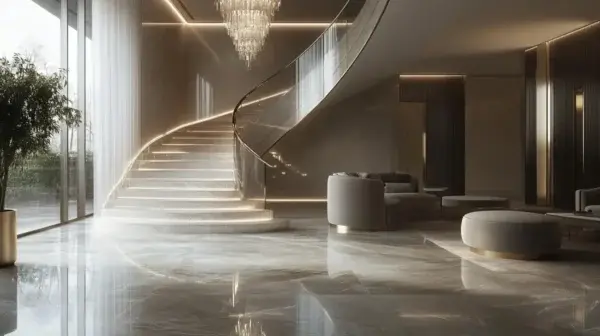
Modern floating staircases are gorgeous. They also feel ungrounded, because nothing visually holds them down. Feng shui values stability, and a stair anchored by a solid wall or by closed storage underneath sits better than one that appears to float from nowhere. If you already have a floating stair and love it, you can ground it with a substantial piece of furniture at the base, a runner, and warm lighting so the eye has something to land on. I say this as someone who used to think floating stairs were the only modern option, until I stood at the bottom of one and felt slightly dizzy. The look is worth keeping. You just have to give it something to sit on.
The fixes that need no tools
Most of what I’ve described so far works in a rental. None of it needs a drill, which is why this is the first set of moves I reach for:
Hang a curtain or a beaded strand just inside the door to slow the sightline. The eye hits cloth instead of the climb.
Place a solid console table or a tall plant between the door and the first step, something with weight that tells energy to pause.
Lay a contrasting rug at the base of the stairs so the eye stops and shifts.
Keep the stairwell well lit and uncluttered so the eye has somewhere to land instead of sliding past into a cold gap. A dark, stuffed stairwell drags the whole entry down.
One move I like is a pivoting screen, angled just enough to bend the path of the eye. It looks intentional and it does the job.
When the stair faces a bedroom door
This problem moves around. A staircase directly outside a bedroom door keeps that threshold busy and loud, and the bedroom is for rest. A new stair isn’t the usual answer. The pause trick works here too, so a screen or a solid piece of furniture between the stair and the door lets the bedroom stay calm. If you want the bedroom-specific version of this, I’ve written it up separately on the bedroom door page. And if the real issue is the front door itself, the front door guide covers where energy enters and what blocks it.
Common Questions
My staircase faces the front door. Is that the worst case?
It’s the setup I’m called about most often, and it’s worth fixing, but I wouldn’t call it the worst. The complaint is always the same: the entry never feels calm. You fix it by slowing the eye at the base of the stairs with a screen, a plant, or a rug. You’re just pointing the eye somewhere else, not building a wall over the stairs.
Can I fix a staircase at the front door without renovation?
In almost every case, yes. The trick isn’t construction, it’s distraction. Something soft just inside the doorway, a piece of furniture with some weight near the steps, and a colored rug at the foot of the stair will pull the eye sideways. A contractor never needs to be involved.
My staircase is in the center of the house. What do I do?
You can’t relocate a stair, so the move is to make the middle feel lived-in, like a spot you’d actually use rather than a corridor you hurry through. Keep it bright, keep it open, and don’t let storage pile up there. If you’re still apartment hunting, steer toward a layout where the stair runs along an outside wall.
Are floating staircases bad feng shui?
Not bad, just a bit weightless. Because nothing visually anchors them, they can feel unstable. If you already have one, ground it with a low cabinet or a bench at the bottom, a runner, and warmer light. They look great; they just need something to settle on.
The stair lands right outside my bedroom door. Is that the same problem?
It’s the same situation, just in another room. A stair next to a bedroom door keeps that entrance busy when it should be quiet. The pause trick applies: put a screen or a bookcase between the stair and the door so the bedroom stays calm. I’ve written more about that on the bedroom door page.
I rent. What can I actually do about a bad staircase?
Most of it. Curtains, plants, rugs, screens, and better lighting are all things you can undo when you leave. I give these to renters first because they change the feel without touching the structure or asking the landlord.
