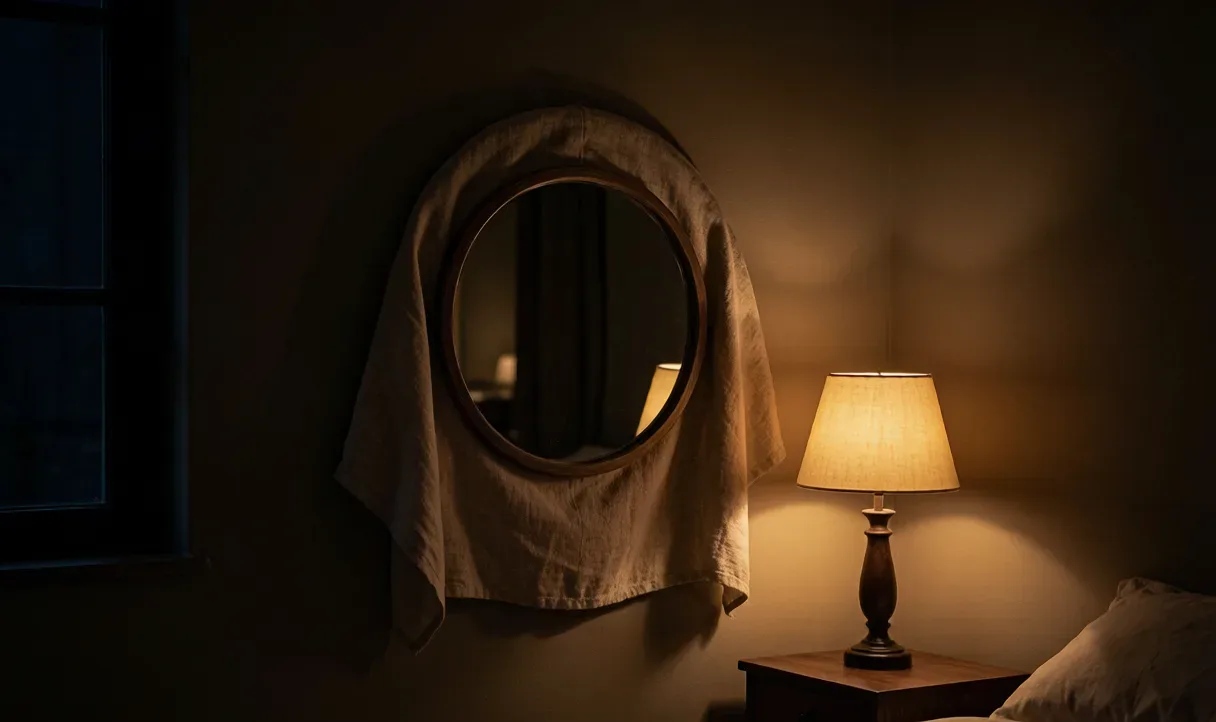

A client sent me a video of her bedroom. A full-length mirror mounted on the wardrobe, angled straight back at the mattress. “I sleep fine,” she said, “but my partner wakes at 3 a.m. every night. Could this be it?” It could. A mirror facing the bed is the most repeated warning in the whole tradition, and the reason is practical.
Cover or angle the glass so it stops reflecting the mattress, and the friction usually goes within a few nights.
The case: a wardrobe mirror that could not move
The client was a renter. The mirror was built into the wardrobe door, and she could not take the door off. She had been married five years, and the rough nights had started sometime in the second year. She blamed the mattress, then stress, then her coffee. Nobody blamed the glass.
We angled the wardrobe door a few degrees so the mirror caught the wall instead of the pillow. The shape of the room did not change. The bed did not move. The cloth test was not even needed, because the angle change was enough. Her partner’s 3 a.m. waking eased within a week.
That is the typical mirror case. The room’s geometry is fixed, the bed cannot move, and the fix is on the glass.
Why the reflection bothers sleep
The classical logic is straightforward. A bedroom is meant to be yin, quiet, dim, a place where the day winds down. A mirror is the opposite: bright, active, forever echoing whatever sits in front of it. Park your sleeping self inside that reflection and the room never fully powers down.
Set the folklore aside for a moment, because there is a plain physical reason this one sticks. You half-wake at 3 a.m., catch a flicker of movement in the glass, and you start awake for a beat before your brain catches up. Do that enough nights and your sleep gets thin. You do not need to believe in qi for that to happen. The trigger is the moving image, not the tradition behind it.
I see this most in rentals where the mirror is built into the wardrobe and cannot be moved. The fix is the angle, not the mirror.
The fixes, none of which need a drill
- Throw a cloth over it at night. A scarf, a tea towel, a piece of fabric you already own. The point is not ceremony. The point is to kill the active reflective surface while you are in bed. Pull it off in the morning and the room looks exactly as you like.
- Angle the mirror to a wall. If the wardrobe sits on a pivot, or you can wedge a small shim behind the bottom edge, tilt the glass a few degrees so it catches the wall and not the mattress. This is the fix I gave that client.
- Tuck it behind a door. A standing mirror that is useful when open and invisible when shut does no harm. The only mirror that bothers sleep is the one your closed eyes could still feel reflecting you.
- Move the bed if you can. Last resort, but sometimes the simpler move is the bed, not the glass.
One detail people miss: it is the open, facing glass that is the issue, not the mirror’s existence. A mirror on the inside of a closet door, kept shut at night, is fine. So is a mirror you would only catch in your peripheral vision while sitting up, not lying down. The trouble starts when the glass holds your sleeping shape in its frame all night.
What the mirror is reflecting matters
This is where most advice stops short. The trigger is movement, not reflection in the abstract. A mirror that faces a still wall reflects a still wall, and you will rarely notice it. A mirror that catches a window with a streetlight, a television left on standby, or a hallway where someone walks past is reflecting motion, and that is what pulls you awake.
When I read a bedroom, I check what the glass actually holds before I recommend anything. A homeowner called about a mirror she could not angle, fixed to the wall opposite the bed. The real trigger turned out to be the television behind her, left on standby, its dim blue glow caught in the glass all night. We covered the mirror and switched the TV off at the wall, and the 3 a.m. starts stopped. The mirror was the frame, but the motion inside it was the cause.
If the mirror reflects a window, the cheap win is a heavier curtain or a movable screen between the bed and the glass. Sometimes the fix is not the mirror at all. It is what the mirror catches.
Mirror size and height matter
The trouble scales with the glass. A small mirror on the dresser, set low, rarely holds your sleeping shape and rarely matters. A full-length sheet opposite the pillow is the worst case, because it frames you head to foot every night.
If you are choosing a new mirror, keep it off the wall you face from the bed, or place it where you only catch it standing, not lying down. Size and angle together decide whether the glass is a problem at all.
Why one partner feels it and the other does not
This comes up in nearly every couple I read. One person sleeps through the flicker, the other half-wakes and starts. The difference is usually sleep depth, not sensitivity to qi. A light sleeper near the glass takes the hit. The deeper sleeper on the far side never notices.
If only one of you wakes thin, swap sides for a week before you cover the glass. The test settles it faster than any theory, and it costs nothing.
The cloth test, and when to skip it
The cloth test is the cheapest diagnosis you have. Throw something over the glass for seven nights and watch the rough waking. If it eases, the mirror was the culprit and you keep the cloth or angle the glass for good. If nothing changes, the glass is clear and you look elsewhere, at light, sound, or the bed itself.
Not every mirror facing the bed needs covering. If the glass reflects a still, dark wall and you sleep through the night, leave it. The test is your sleep, not the rule. The wider bedroom picture is in the bedroom feng shui guide, and the whole-home overview covers the rest of the rooms.
Common Questions
Is a mirror facing the bed really bad?
It is a friction point, not a catastrophe. The reflection keeps a restful room from switching off and can startle you awake at night. Cover or angle it and the problem usually eases.
What is the easiest fix if I cannot move it?
Throw a cloth over it at night, angle it to a wall, or tuck it behind a door. All three are free and reversible, and none need tools.
Why does it affect one partner and not the other?
This comes up in nearly every couple I read. One person sleeps through the flicker, the other half-wakes and starts. The difference is usually sleep depth, not sensitivity to qi. A light sleeper near the glass takes the hit. The deeper sleeper on the far side never notices.
If only one of you wakes thin, swap sides for a week before you cover the glass. The test settles it faster than any theory, and it costs nothing.
The cloth test, and when to skip it
The cloth test is the cheapest diagnosis you have. Throw something over the glass for seven nights and watch the rough waking. If it eases, the mirror was the culprit and you keep the cloth or angle the glass for good. If nothing changes, the glass is clear and you look elsewhere, at light, sound, or the bed itself.
Not every mirror facing the bed needs covering. If the glass reflects a still, dark wall and you sleep through the night, leave it. The test is your sleep, not the rule. The wider bedroom picture is in the bedroom feng shui guide, and the whole-home overview covers the rest of the rooms.
Common Questions
Is a mirror facing the bed really bad?
It is a friction point, not a catastrophe. The reflection keeps a restful room from switching off and can startle you awake at night. Cover or angle it and the problem usually eases.
What is the easiest fix if I cannot move it?
Throw a cloth over it at night, angle it to a wall, or tuck it behind a door. All three are free and reversible, and none need tools.
Why does it affect one partner and not the other?
Some people sleep through the flicker; others half-wake and startle. If you or your partner wake thin and the mirror faces the bed, it is worth testing first.
Do mirrored closet doors count?
Yes, they are the built-in version of the same problem. Keep them closed at night or hang a curtain rod with fabric across them, and the room settles.
Can a mirror facing the bed cause bad dreams?
Not in any literal sense, but a surface that flashes movement at 3 a.m. can pull you into lighter sleep where dreams feel sharper. Same trigger, same fix.
About the author
Sanhe (Guo Yutong) is the founder of Fengshuipower. Trained in classical feng shui, she reads floor plans and photos from anywhere in the world and sends a written plan you can act on. The bedroom feng shui guide is the long version of this article.
