
By Sanhe · Founder of Fengshuipower, trained in classical feng shui · Published July 15, 2026· ~13 min read
Let me tell you about a client. She had a red front door she loved, the kind of door that makes people slow down on the street. The trouble started three steps inside. The door opened straight onto a flight of stairs, so the moment anyone came in, the eye ran up and out, and the entry never settled. She told me the house felt like it could not hold onto anything, money included. We set a console table at the base of the stairs, a tall plant to the side, and a heavier rug to slow the step. Three weeks later she said the place felt grounded for the first time in years. Same red door. The stairs had been pulling everything up and away.
I start there because the front door is the most honest part of feng shui. It is the one piece of the home every visitor meets before they meet you. Front door feng shui is the practice of arranging the entry so the act of coming home feels clear, welcomed, and calm. It is not a charm that lifts your income, not a cure for a broken lock, and not a way to change your life by painting a door red. It is about keeping the path open, the light warm, and the sightline gentle.
This guide moves the way I do in a consult, from the door itself out to the path that leads to it. Each section points to a deeper read on that subtopic.
In this guide
- What front door feng shui actually changes
- Why the front door is the mouth of the house
- Door color: what works and what competes
- Direction: what your door faces
- A clear path to the door
- Door facing the stairs
- Door facing another door
- Mirrors and the front door
- Light at the threshold
- Plants and water by the door
- A door that works: repair and care
- What to keep away from the door
- The small or awkward entry
- Common questions
- About the author
- Continue reading
What front door feng shui actually changes
Most of the fear around the front door comes from people expecting it to do something it cannot. What it does well is concrete. It keeps the path to the door clear so you are not greeted by clutter. It puts light at the threshold so the house looks awake. It turns the door away from the stairs so energy does not rush straight out. None of this pays a bill. All of it changes how the house feels when you put the key in, and that feeling is the part worth having.
If you are skeptical, that is reasonable. An entry quietly rewards what is open and quietly punishes what is blocked, and that holds whether or not you use the word qi. The rest of this guide is about the open and the blocked, with as little folklore as I can manage.
The front door is the mouth of the house
In the old texts the front door is called the mouth of the house. It is where the outside world meets the inside one. Whatever meets you at the door is what you carry into the rest of the home.
A door that opens onto a pile of shoes tells the day you are behind before it starts. A door with a clean frame, a clear step, and a light above it tells the day you are ready. The door does not decide your life. It sets the tone the rest of the rooms have to work with.
The practical version is the same as the poetic one. Make the mouth of the house a place that is clean, lit, and easy to pass through, and the rest of the home has a better start.
Door color: what works and what competes
Door color is the most asked question in front door feng shui. The answer depends on the door’s element and the wall around it.
- Wood doors suit green, brown, or wood stain.
- Metal doors suit white, gray, or silver.
- Red is the classic welcome color in many traditions, but a red door on a red wall disappears, and a red door in a bare, cold entry can feel harsh.
- Black and deep blue belong to Water. They read as still and protective, but they can feel heavy if the entry is small or dark.
The practical rule is this: pick a color that makes the door readable from the street, that stands a little apart from the wall, and that you actually like looking at every day. A door you enjoy opening is a door that gets opened with care. For the full color logic, including direction-by-direction shades, see the front door color guide.
Direction: what your door faces
People ask which direction a front door should face, and the honest answer is that the best door is the one you have. You rarely choose the facing when you buy or rent a home. What you can choose is what the door meets.
The bagua map assigns each direction a theme: north for career, south for recognition, east for family, west for children and helpful people, and so on. A door that faces east is said to draw in fresh starts. A door that faces south draws in warmth and visibility. These are gentle leanings, not laws. The stronger factor is what is in front of the door. A door that faces a blank wall three feet away feels boxed in. A door that faces open space, a garden, or a quiet street feels free.
If your door faces a wall or a busy road, you soften it with light and a plant, not by rotating the house.
A clear path to the door
The path from the street to the door is the first thing the house takes in. If that path is blocked, the house takes in blockage.
Three moves cover most entries:
- Clear the step. No shoes, no deliveries, no dead plant by the threshold. The step should be bare enough to wipe your feet on.
- Clear the sightline. From inside, looking out, you should see sky or garden, not a wall of mail and coats. A narrow console with one tray beats a wide shelf of junk.
- Clear the threshold. The door should open fully without hitting anything. A door that catches on a rug or a box feels like a home that cannot quite receive you.
A client moved a bike and a stack of boxes out of the entry and said the whole flat felt larger the same afternoon.
Door facing the stairs
This is the layout that worries people most, and it is worth taking seriously. The door opens and the stairs pull the eye, and the energy, straight up and away. In practice the home feels like it cannot hold what comes in, because the first thing inside is an exit upward.
The fixes are layered, from free to structural:
- Slow the step. A heavier rug at the base of the stairs brakes the eye.
- Break the line. A console table or a tall plant between the door and the stairs cuts the straight shot.
- Add weight low. A solid piece of furniture at the stair foot anchors the space.
- Keep the stairs lit. A light on the wall by the stairs keeps the upward pull visible, not lurking.
A family I worked with had the door open onto a steep stair. We did every free fix first: a runner rug, a fiddle-leaf fig in a heavy pot, and a small lamp on the console. They reported the entry felt calm within a month.
Door facing another door
Two doors facing each other, one inside and one out, or two interior doors across a hall, create a straight line that rushes energy through. The fix is to slow it.
- Close the interior door when the entry is not in use, so the line does not run through the whole plan.
- Offset the sightline with a plant or a piece of furniture at an angle.
- Soften the frame with a curtain or a screen if the doors must stay open.
The point is not ritual. A straight shot from the street through the home leaves no room for the eye to settle, and the rooms in between feel like a hallway rather than a home.
Mirrors and the front door
A mirror facing the front door bounces the home’s welcome straight back out the moment the door opens. In practice, the door swings and the mirror throws the entry’s warmth right back to the street. People describe a home that will not hold onto visitors.
Place the mirror on a side wall instead, perpendicular to the door. If it must sit where it catches the door, angle it a few degrees so it does not face the opening directly. A mirror in the entry is still useful for a last look before you leave, just not aimed at the threshold.
Light at the threshold
A dark entry feels like a home that never quite wakes. Light is the cheapest fix in the whole practice.
Start with what the door has. If there is a porch light, use a warm bulb and leave it on at dusk. If the entry is indoors, add a fixture above the door and a small lamp on a console. Warm bulbs around 2700 to 3000 Kelvin copy daylight without the harshness.
A client with a windowless entry added a warm sconce and a small mirror on the side wall, and said the flat stopped feeling like a cave.
Plants and water by the door
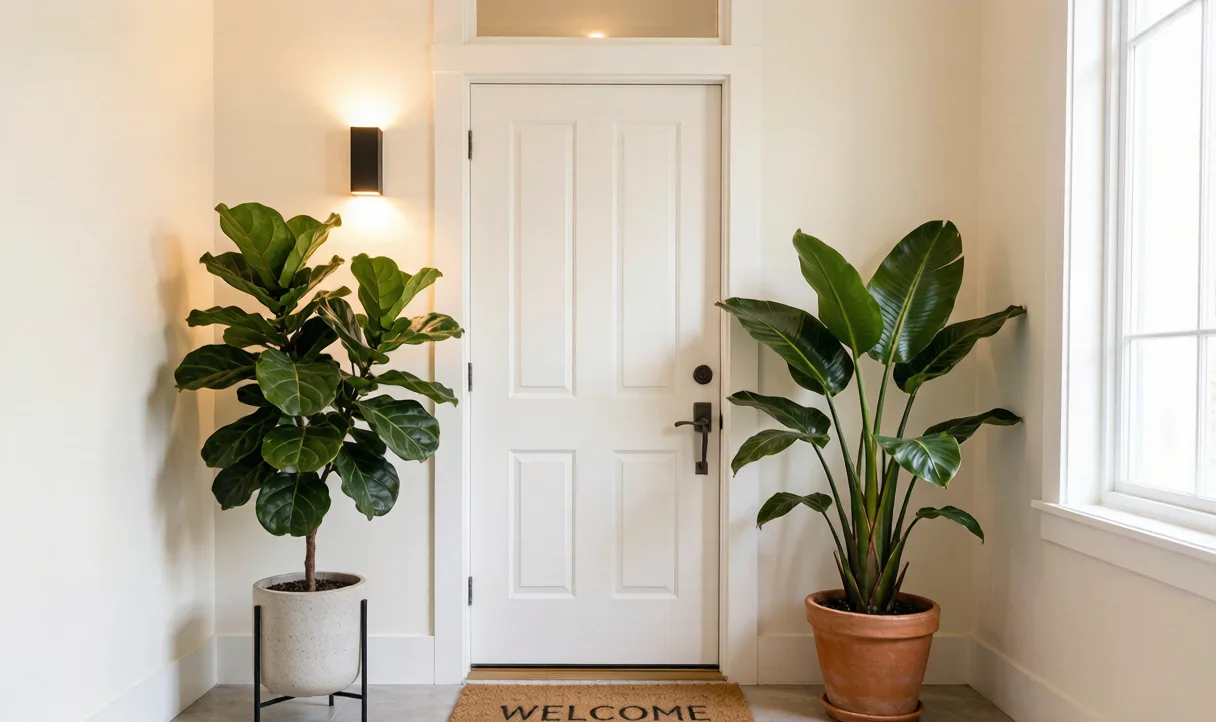
A plant by the front door is the easiest life boost in the entry. It signals that something is alive and cared for at the exact point where the outside meets the inside. A snake plant, a peace lily, or a small olive tree by the door works in most light.
A few rules:
- Upward growth, not trailing. A plant that reaches up lifts the entry. One in a heavy pot works harder than a trailing vine.
- Nothing dying. A wilting plant at the mouth of the house looks like neglect you chose. Swap it the day it turns.
- Skip the water feature indoors. A small fountain at the threshold sounds nice and drains energy in the wrong way. Keep water outside, if at all, and away from the door.
A door that works: repair and care
A front door that sticks, squeaks, or will not latch tells the house it is not quite receiving you. The fix is maintenance, not magic.
- Oil the hinge so the door opens without a groan.
- Fix the latch so it closes with a solid click.
- Repaint the frame if the paint is chipped, because a cared-for frame signals a cared-for home.
- Replace the handle if it is loose, since the handle is the first thing a guest touches.
A client ignored a sticking door for a year and said the whole entry felt like an apology. We oiled the hinge and replaced the handle, and the house felt open the same week.
What to keep away from the door
Some things near the front door work against the entry more than people expect.
- The bathroom door. If the front door opens onto a bathroom, the home’s welcome lands on a room built for release. Slow it with a screen or a closed door.
- The kitchen. A door that opens straight into the cooking zone rushes the calm of arrival into the busiest room. A console or a plant between them helps.
- A mirror facing out. Covered above.
- Clutter and bins. Covered in the clear-path section.
If the layout forces a door-near-bathroom or door-near-kitchen case, the bathroom door feng shui guide maps the cheapest fixes.
The small or awkward entry
Small entries punish clutter twice as hard, because every item carries more visual weight and the path has nowhere to go. The rules are the same as a large entry, just applied at higher resolution.
- Clear the path first. If you can only do one thing, keep the floor and the step clear.
- Light, not dark. A warm light makes the entry recede and feel larger.
- One plant, placed high or to the side. Lifts without crowding the step.
- One tray, not a shelf. A single catch-all tray signals order; a wide shelf of mail signals drift.
A small entry is not a smaller version of the same rules. It is the same rules with less margin for error.
When to stop reading
Front door feng shui is not a project to finish. It is a set of habits to keep. Stop reading when the path is clear, the door is lit, the color makes you glad to open it, the stairs or the mirror are no longer in the straight line, and it feels good to come home. Most people hit that point inside two weeks of small moves.
If the entry still nags, the next layer is the routine: a wiped step, a lit threshold, a plant that reaches up. And then, only if you want it, the deeper reads on the cluster pages below.
Common questions
Which direction should my front door face?
The best door is the one you have, because you rarely choose the facing when you buy or rent. What you can choose is what the door meets. The bagua map gives each direction a gentle theme, but the stronger factor is the space in front of the door. A door that faces open space or a quiet street feels free; a door that faces a blank wall three feet away feels boxed in. Soften a hard facing with light and a plant.
What color is best for a front door?
It depends on the door’s element and the wall around it. Wood doors suit green or brown, metal doors suit white, gray, or silver, and a red door is the classic welcome color in many traditions. The practical rule is to pick a color that makes the door readable from the street, stands a little apart from the wall, and that you like looking at every day. A door you enjoy opening gets opened with care.
Is a red front door good?
Yes, in most traditions red is the color of welcome and protection, and it is a strong choice for a front door. The catch is contrast. A red door on a red wall disappears, and a red door in a bare, cold entry can feel harsh. Make sure the rest of the entry has some life, a plant or a light, so the red comes across as welcome rather than warning.
Is a mirror facing the front door bad?
Yes. A mirror opposite the door bounces the entry’s welcome straight back out the moment the door opens, and people describe a home that will not hold onto visitors. Place the mirror on a side wall, perpendicular to the door, or angle it a few degrees so it does not face the opening. A mirror in the entry is still fine for a last look, just not aimed at the threshold.
What if the front door faces the stairs?
The door opens and the stairs pull the eye, and the energy, straight up and away. The entry never settles, because the first thing inside is an exit upward. Slow it with a heavier rug at the stair base, break the line with a console or a tall plant, add weight low with a solid piece of furniture, and keep the stairs lit.
What if two doors face each other?
A straight line from one door to another rushes energy through and leaves no room for the eye to settle, so the rooms in between feel like a hallway. Close the interior door when the entry is not in use, offset the sightline with a plant at an angle, and soften the frame with a curtain if the doors must stay open.
Should the front door be visible from the street?
Ideally yes. A door that hides behind overgrowth or a wall is hard to reach, and the path to it feels uncertain. Keep the number visible, trim what blocks the view, and light the step at dusk. A clear, lit, findable door welcomes the day in.
Can the front door face a bathroom or kitchen?
It can, but a door that opens onto a bathroom lands the home’s welcome on a room built for release, and a door that opens into the kitchen rushes calm into the busiest room. Slow both with a screen, a console, or a tall plant between the door and the room, and keep the inner door closed.
What should I keep by the front door?
One plant that reaches up, a single tray for mail and keys, and a light you actually turn on. That is enough. Skip the water fountain indoors, the dead plant, and the stack of boxes, because each one works against the entry.
Does a broken front door really matter?
It does, because a door that sticks, squeaks, or will not latch tells the house it is not quite receiving you, and the entry feels like an apology. Oil the hinge, fix the latch, repaint a chipped frame, and replace a loose handle. A client who ignored a sticking door for a year said the house felt open the week we fixed it.
About the author
Sanhe (also known as Guo Yutong) is the founder of Fengshuipower. Trained in classical feng shui, she works with clients worldwide through online consultation reports, reading floor plans, photos, and BaZi charts from anywhere. Her approach borrows the rigor of the old texts and leaves the folklore at the door. She writes the practical guides on this site.
If you want a practitioner to read your specific door, your facing, your stairs, and the rest of the plan, that is what a consultation is for. I work with clients worldwide, entirely online, and the first read is usually the one that catches the issue no list of rules could have predicted.
