
She texted me a photo at 11 p.m. Five pots on the dresser, two on the floor, a trailing vine knotted around the headboard. “I love them,” she wrote, “but I have not slept through a night in weeks. Is it the plants?” The short answer on plants in bedroom feng shui is this: most plants are fine, but the wrong ones in the wrong spots will quietly work against your rest.
Plants in the bedroom are not a curse and not a cure. They are furniture with roots. The real question is which ones you keep, how many, and where they sit while you are trying to sleep.
The broad, plant-by-plant overview is in our plant feng shui guide. For the wider bedroom picture — light, layout, and the bed itself — see the bedroom feng shui guide.
Fix 1: Skip the spiky shapes
A cactus or a thorny succulent pointed at the pillow carries the same sharp feel as a furniture corner jabbing into your resting space. I have had clients swear a bedside cactus made the room feel edgy in a way they could not name. Move it to the home office. The pointed energy is not a spell, just a visual tension most bodies notice before the mind does.
If you love cacti, keep them where you work, not where you sleep. The desk benefits from the alertness you are trying to soften at the bedside.
Fix 2: Replace the trailing vine over the headboard
A trailing vine looped over the headboard visually traps the bed, and most people sleep worse with something dangling above their face. I tell clients to keep the air above the mattress open. Plants on solid surfaces. Nothing hanging where you cannot fully see it.
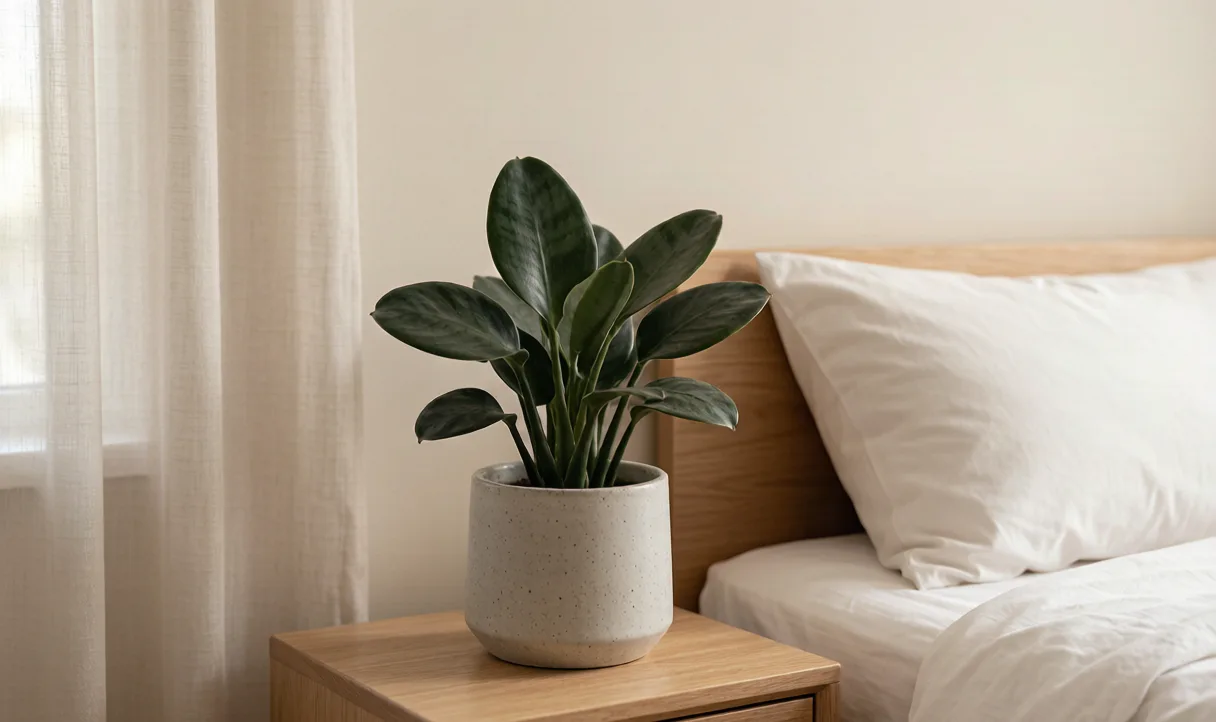
If you want greenery near the bed, a small upright plant on the nightstand does the same job without the canopy effect.
Fix 3: Move the strong-smelling plants out
Lavender and strongly scented herbs can be lovely in a living room, but a smell you cannot escape for eight hours gets old fast. Some clients have woken with a headache they could not trace until the plant moved. The smell itself is not the problem. It is the constant exposure with no break.
A test I give clients: would you be happy to see this plant at 3 a.m.? If the answer is no, it does not belong by the bed.
Fix 4: Toss the dying plants fast
A withering plant by the bed does more harm than an empty corner. A dying thing reads as neglect you chose, and the eye tallies it in the small hours. There is no third option that helps. Either revive it or remove it.
The plant feng shui guide covers the species most likely to wilt in a dim bedroom and the swap-outs that hold up.
Fix 5: Keep the count to one or two
A shelf of twenty pots crowds the space, collects dust, and turns “I like greenery” into “I am running a greenhouse I cannot keep up with.” One or two modest plants is plenty. If you share the room, agree on the count before the third pot appears, because the person who waters rarely is the one who ends up resenting the jungle.
The species I actually let near a bed
Soft, rounded leaves are the safe pick. A snake plant is my go-to for bedrooms: upright, tolerant of weak light, forgiving of forgotten waterings, and asking for almost nothing. A small pothos on a nightstand works too, as long as you keep it alive and tidy. A peace lily is the third pick, but it wants more consistent watering than the snake plant and sulks when you forget.
These plants read as calm, and calm is the whole job of a bedroom.
Where to put them
Placement matters more than people expect. A small plant on a nightstand sits beside you, quiet and contained. A plant on the dresser at the foot of the bed is also fine. The rule is: keep it upright, keep it off the floor near the bed, keep it where you can see it during the day and forget about it at night.
Light is the hidden constraint. A plant shoved into a dark corner behind the bed will sulk, then die, then become exactly the withered thing we just agreed to avoid. Match the plant to the light you actually have, not the light you wish you had. A snake plant tolerates a dim room. A fern will not. If your bedroom is tiny and the only light sits by the window, put the plant on the windowsill, not on a box stacked against the glass behind the bed.
The oxygen myth, settled
The oxygen fear is the first thing people raise, so let us settle it. Most plants do take in oxygen and release carbon dioxide after dark. A few pots in a normal bedroom use a rounding error of the air. You will not wake up suffocated because of a pothos.
I tell clients to stop worrying about respiration and start worrying about the shape, the mood, and the upkeep of what they keep. The air-cleaning benefit is real but minor, so treat it as a bonus, not the reason to keep a plant.
Dust and humidity
Big leafy plants drink and breathe, and in a sealed bedroom that can nudge the humidity up overnight. For most people that is nothing. For someone prone to stuffy sinuses or walls with a damp history, it is worth noticing. Keep the leafy crowd small and crack a window when the weather allows.
Dust is the quieter issue. Every pot is a small shelf for it, and the bedroom is where you breathe eight hours straight. Wipe leaves when you water, and do not let pots collect a rim of dry soil that flakes onto the floor.
Trust your own body over any rule
If you have kept one calm plant for years and slept like a stone, the advice about bedrooms being plant-free does not apply to you. The clients who do best keep what soothes them and drop what does not, instead of forcing a textbook arrangement onto a room that already works.
Common Questions
Do bedroom plants really steal your oxygen at night?
Only a rounding error of it. A few pots in a normal bedroom will not suffocate you. The shape and upkeep of the plant matter far more than its respiration.
Which plants are safest by the bed?
Snake plant, pothos, and peace lily are calm, low-maintenance picks with soft leaves. Skip cacti and anything spiky pointed at the pillow.
How many plants are too many in a bedroom?
One or two modest ones. Past that the room starts to read as a greenhouse, and dust and neglected watering follow.
Is a dying plant bad for bedroom feng shui?
Yes. Dead or yellowing leaves read as stuck energy and look like chosen neglect. Remove a withered plant before adding a healthy one.
Can I keep a vine plant trailing from the headboard?
Best not to. A trailing vine over the headboard visually traps the bed. Keep the air above the mattress open and put plants on solid surfaces instead.
About the author
Sanhe (Guo Yutong) is the founder of Fengshuipower. Trained in classical feng shui, she reads floor plans and photos from anywhere in the world and sends a written plan you can act on. For the plant-by-plant overview, the plant feng shui guide is the broad version; for the full bedroom layout, see the bedroom feng shui guide.
