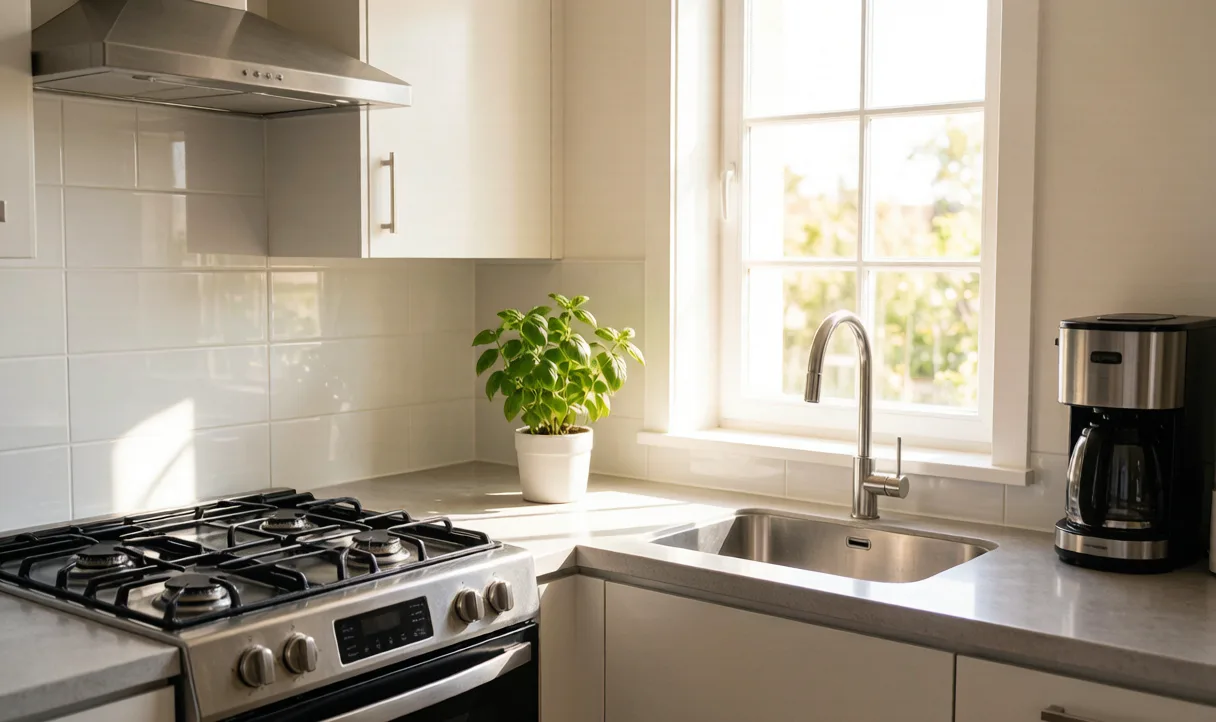

Stove and Sink Feng Shui Without the Panic
The stove and sink sit close together in almost every kitchen built in the last hundred years. That’s just how cooking works: you boil water a foot from where you fry the onions. So when a well-meaning friend announces that your stove and sink are “fighting” because one is fire and the other is water, the honest answer is that they are not fighting. They are doing the job you installed them to do.
The panic version of this advice tells people to renovate. Move the island. Build a wall. Tear out a counter. I’ve had clients in Los Angeles and Leeds call me in near-tears because a blog post convinced them their kitchen was cursed. It isn’t. Let me walk you through what the stove-and-sink question actually asks of a space, and which fixes are worth your Saturday afternoon.
Why the “fire and water clash” idea exists
Traditional Feng Shui groups things into five elements: wood, fire, earth, metal, water. The stove reads as fire. The sink reads as water. In the cycle, water puts out fire, so placing them directly across from each other can feel, in the old language, like two forces pulling in opposite directions.
That’s a description of energy movement, not a prediction of doom. A kitchen where you can’t move without bumping a cabinet is a real problem. A kitchen where the tap sits eighteen inches from the burner is Tuesday. The vast majority of homes are not textbook layouts, and the practice was built for farmhouses and courtyards, not 600-square-foot city apartments with a galley kitchen.
What I actually look at is whether the space feels usable and calm when you cook. If it does, the elemental pairing is doing its job quietly. If it doesn’t, the cause is almost always clutter or poor sightlines, not some elemental war.
The fix that actually works: a Wood buffer
In the five-element cycle, Wood sits between Water and Fire. It feeds Fire and is nourished by Water, so it acts as a soft bridge rather than a wall. You don’t need a renovation to introduce it.
A small plant on the counter between the two. A wooden cutting board propped where you can see it. A green mat on the floor, or a wooden utensil crock. One of these is enough. I tell clients to pick the option that fits how they already use the kitchen, not the one that looks most “Feng Shui.” The plant that dies in a dark corner does more harm than the element it was meant to fix.
The point of the buffer is sensory, not magical. Your eye lands on something living and warm in the gap between two hardworking appliances. The kitchen reads as a place, not a machine.
The stove’s backing matters more than the gap
Here is what I check before I ever mention the sink. A stove with a solid wall behind it gives you a sense of support while you cook. Your back is covered. You’re not spinning to see who walked in.
If your stove is on an island with your back to the room, that’s the real issue people feel but can’t name. The fix is cheap. A reflective backsplash behind the cooktop, or a small mirror on the side of a nearby cabinet, lets you catch movement in your peripheral vision. Clients tell me the difference is immediate: they stop feeling exposed while they’re at the stove.
This single change does more for how a kitchen feels than any argument about fire and water ever will.
Keep the counters between them clear and dry
Clutter on the strip between stove and sink reads as chaos, and cooking already asks enough of your attention. Sauce bottles, mail, a phone charging on a greasy tile, a pile of unopened mail, the kids’ homework. It all stacks up exactly where you need a clear line of movement.
Wipe it down at the end of the day. Keep that one stretch of counter empty. It’s the simplest version of the whole practice: a clear path where energy and you both need to move.
I’ve walked into $2 million homes with this one strip packed solid, and tiny rental kitchens where it was pristine. The calm followed the clear counter, not the square footage.
Lighting and color do quiet work
A dim kitchen feels heavy no matter where the stove sits. Under-cabinet lights over the prep zone, a warm bulb rather than a cold fluorescent, a soft green or cream on the walls. These shift how the room sits in your body when you stand in it.
If you want a wooden or green note near the stove and sink, that’s the Wood buffer doing double duty as color. One choice, two effects. You don’t need to paint the whole kitchen.
When you should actually pay attention
There are a few layouts worth a real conversation, and they’re rarer than the panic suggests.
The first is a stove that faces the front door across an open plan, so anyone walking in sees the burner directly. That scatters the home’s focus outward. A tall plant or a partial screen near the doorway usually settles it.
The second is a cooktop wedged into a corner with zero landing space on either side, so you’re balancing hot pans over the sink. That’s a safety and flow problem first, an elemental one second.
If neither describes your kitchen, you’re done. You don’t need to gut anything.
What I tell clients in person
A woman in Manchester showed me her kitchen on a video call, convinced the stove-sink pairing was why her family felt scattered at dinner. The real problem was a counter buried in chargers and school papers. We cleared it, added a small wooden board between the appliances, and put a mirror tile on the island end so she could see the hallway. Two weeks later she said dinner felt different. Not because the elements stopped fighting. Because the room finally let her breathe.
That’s the whole thing. The stove and sink were never the problem. The space around them was.
If your kitchen has one of the rare layouts above, or you want a reading of your own home’s flow, I do one-to-one consultations and I’ll look at your actual floor plan, not a rulebook. You can read more practical kitchen and home adjustments in our feng shui tips, or start with the dining room guide if your kitchen opens to where you eat.
Common Questions
Is it bad Feng Shui to have the stove next to the sink?
Not in most homes. Modern kitchens place them close by design, and the pairing only becomes a problem when the space around it feels cramped, cluttered, or exposes your back while you cook. A small Wood element between them is usually all you need.
What can I put between my stove and sink for good Feng Shui?
A small live plant, a wooden cutting board on display, a green mat, or a wooden utensil holder. Pick one that fits how you actually use the kitchen. The goal is a warm, living note in the gap, not a showpiece.
My stove is on an island with my back to the room. Is that bad?
It can feel unsettling because your back is uncovered while you cook. A reflective backsplash or a small side mirror lets you see movement behind you, which settles the feeling without moving a single appliance.
Should the stove face the sink directly?
Side by side is fine. Directly facing across an island is the layout people describe as tense, and a Wood buffer or a clear, uncluttered counter between them takes the edge off. It is not worth a renovation.
Does the stove need a solid wall behind it?
It helps. A solid wall gives a sense of support while you cook. If yours is on an island, mimic that backing with a reflective surface so you’re not cooking blind to the room. This matters more than the stove-sink distance.
