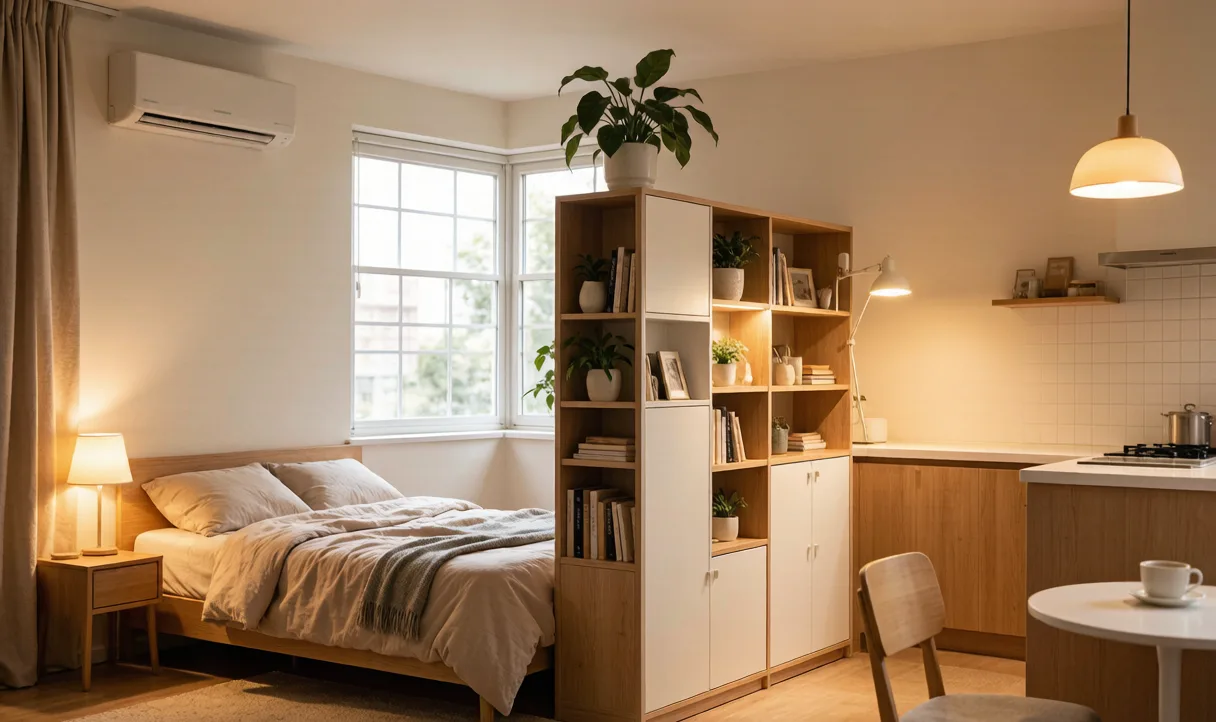

Studio apartment feng shui comes down to a single move. In a one-room home, give sleep, work, and cooking each a felt boundary so the energy doesn’t run together and your body stops guessing which mode it’s in.
I walked into a studio not long ago where the bed sat about eight feet from the stove. The tenant, a designer who worked from the same room, told me she’d lie down at night still smelling dinner and still seeing her laptop glow on the folding table. “I never feel off the clock,” she said. That’s the whole problem in one line: when everything shares a floor, your body stops knowing which mode it’s in, and it stays a little wired even when you’re exhausted.
Why a Studio Blurs the Lines
The shape of a studio isn’t the enemy. The missing walls are. In a normal apartment, a bedroom door tells your nervous system it’s time to drop. A kitchen wall says activity stops here. Take those away and the signal goes flat, so your stress and your rest end up living in the same square of carpet.
I tell clients to think of a studio like a stage with no backdrops. The actors keep changing costumes, but the set never changes, so the audience never quite believes the scene has shifted. You don’t need real walls. You need cues your body will read without thinking about them. A change in floor texture, a shift in light color, a piece of furniture that says this side is different.
The sleep corner is where most people go wrong. They push the bed into the only spot that fits and call it done, then wonder why they lie awake. Bed placement still follows the same rule it does in any room, which our bedroom feng shui guide covers in full. Head to a solid wall. Able to see the door, not directly in its line. In a studio that usually means the bed against the wall farthest from the entry, feet pointing inward rather than straight out toward the door. If the only option is against a window, hang a heavy curtain you can close at night so the glass stops reading as an open edge that lets the street in.
This is one reason the open-plan advice I give for larger homes still applies here in miniature. My take on open-concept layouts is really about drawing zones without building walls, and a studio is just that problem turned up to full volume. The same trick of a rug, a light change, and a soft divider does the work whether your room is eight hundred square feet or eighty.
Studio Apartment Feng Shui: Splitting Sleep From Cooking
The kitchen end is the harder split because cooking carries smell, sound, and light, all of which travel farther in an open room than people expect. A visible mess from the pillow reads as chaos you can’t escape, so keep the counters clear and the trash lid shut, especially at night when you’re trying to wind down.
The real divider is something physical between the cooktop and the bed. A tall bookshelf does it. So does a hinged screen or a rolling garment rack hung with curtains. One client used a plant cluster three feet tall and said the room finally felt like two places instead of one confusing one. The key is height: a low item won’t cut the sightline, and your eye will still travel straight from the stove to where you sleep.
There’s a practical reason beyond mood. Cooking is the most active, heat-and-motion corner of any home, and your bed is the stillest. Put them in the same sightline and your body keeps one foot in the kitchen even at midnight. I tell clients the stove is the one appliance a studio can’t hide, so the divider has to do the hiding for it, and a folding screen you can open by day and close at night is the most flexible tool I know.
The goal is the same as in a standalone kitchen: keep the cooking energy from reaching the bed. For the wider kitchen picture, see the kitchen feng shui guide.
The point isn’t to hide the kitchen. It’s to tell your brain the bed zone is for rest, full stop. I’ve seen the same eight-by-ten studio feel cramped or calm based only on whether that line was drawn. Renters can take the screen to the next apartment without a word to the landlord.
Giving the Work Area Its Own Spot
The work corner is the third zone and the easiest to ignore, which is a shame because it’s where a studio quietly breaks people. A laptop on the bed is the worst version of studio apartment feng shui because now the one place meant for rest carries your deadlines, your inbox, and the glow that tells your brain to stay alert. Even a narrow console table against a wall counts as a desk if you treat it that way and pack it away at the end of the day.
When you’re done, close the laptop and slide it into a basket so the work disappears visually. The storage habits I cover in my closet guide matter here too, because a studio with no place to hide clutter will always feel smaller than it is. Out of sight isn’t magic. It’s just your brain getting a break from the to-do list staring at it.
Lighting does a lot of the separating for free. Warm light over the bed, brighter light at the desk, and a different tone near the stove tells the room when to shift gears. You’re not decorating. You’re scheduling the space. I tell clients to use one lamp per zone rather than one ceiling bulb for everything, because a single overhead light flattens the whole room into one unbroken field and your body never gets the memo that the day is over. If your work corner is also meant to support your income, the home office guide goes deeper on desk placement and what actually moves a career forward without turning your rent into a seminar.
What Renters Can Do Without Leaving a Mark
Here’s the thing. Most studio fixes are reversible, and that’s good news if you rent. No drilling, no built-in shelves, no paint you’ll have to undo or lose a deposit over. A freestanding shelf, a curtain on a tension rod, a floor mirror that bounces light and fakes a wall. All of it comes with you. I keep a short list for tenants: a folding screen, a rolling rack, a few tall plants, and one good lamp per zone. That’s the whole kit, and none of it needs permission.
Two things I steer renters away from. Don’t point a mirror at the bed just to fake space, because watching yourself sleep is its own kind of unrest. And don’t hang string lights as your only light source. They read as festive for a night and tired by the third week. Real lamps, real warmth, real boundaries.
Empty space is the cheapest feng shui there is. Don’t fill a studio to fix it. A small home with room to breathe beats a large one packed to the ceiling, and a studio that feels open will always read better than one crowded with cures someone sold you online. The goal is one room your body agrees with, not one room stuffed with objects.
That doesn’t necessarily mean you need to buy anything. The designer I mentioned cleared her counter, moved her bed to the far wall, hung a curtain rod with a linen panel between bed and stove, and shut her laptop in a basket at six. She said she started sleeping through the night within a week. I can’t promise that for everyone, but the logic is simple: when the zones feel separate, you do too, and your sleep stops carrying the weight of the room’s confusion.
If your whole place feels like one unfinished thought, my home feng shui overview walks through every room and how they should talk to each other. And if you want me to read your exact layout, a consultation is the fastest way to get a plan that fits your walls instead of a generic checklist.
I’m the founder of Fengshui Power, trained in the Zhengyi Dao lineage. I work with clients online. Wherever you live, I read your BaZi (Four Pillars) chart and assess your home’s feng shui remotely, then walk you through what to change. My about page explains how I work, and a consultation is where we’d start.
Common Questions
How do I separate the bed from the kitchen in a studio?
Use a tall bookshelf, curtain, or plant cluster as a visual divide so your brain reads a sleep zone and an activity zone. A folding screen between the cooktop and the pillow helps most, and it moves with you when you rent.
Where should the bed go in a studio apartment?
In the commanding position: head to a solid wall, able to see the door without being in its direct line. Put it against the wall farthest from the entry when you can, and avoid a window wall if a heavy curtain isn’t an option. For the full bed-placement rules, see the bedroom feng shui guide.
Is a studio apartment bad feng shui?
Not if you divide it. The open plan blurs rest and activity, but a screen or shelf restores the boundary. Empty space matters more than square footage, so don’t crowd the room trying to fix it.
What are renter-friendly studio fixes?
Reversible ones: a rolling rack with curtains, a freestanding shelf, or a hinged screen. None need drilling and all move with you at the end of a lease.
