
A client showed me the bedroom and pointed at the bed shoved under the window, the head floating with nothing behind it. “I wake up at three most nights,” she said. “Is the room working against me?” Probably. The 3 a.m. wake-up is so common it has its own folklore. The classical explanation is the hour of the tiger, the deepest part of the night when the body’s qi is meant to be at its quietest. The practical explanation is more useful. Something in the room is mildly waking you, and you remember it as a 3 a.m. pattern.
The full bedroom picture is in the bedroom feng shui guide. For the bed alone, the bed placement guide is the load-bearing read.
Two kinds of sleep: the room you trust vs the room you do not
The room you trust is the one that lets you stop listening. Your back has a wall. The door is closed. The mirror is angled away. The window is dressed. The charger is on the dresser, not the nightstand. The room you do not trust is the one where a corner of your mind is still on duty, checking the doorway, watching the glass, listening for the hallway, scanning the pile on the chair. Both kinds of sleep feel like sleep at 11 p.m. Only one of them stays asleep at 3 a.m.
The fixes below move the room from the second kind to the first. None of them are mystical. They are the small things the body registers but the mind does not name.
The bed against the wall
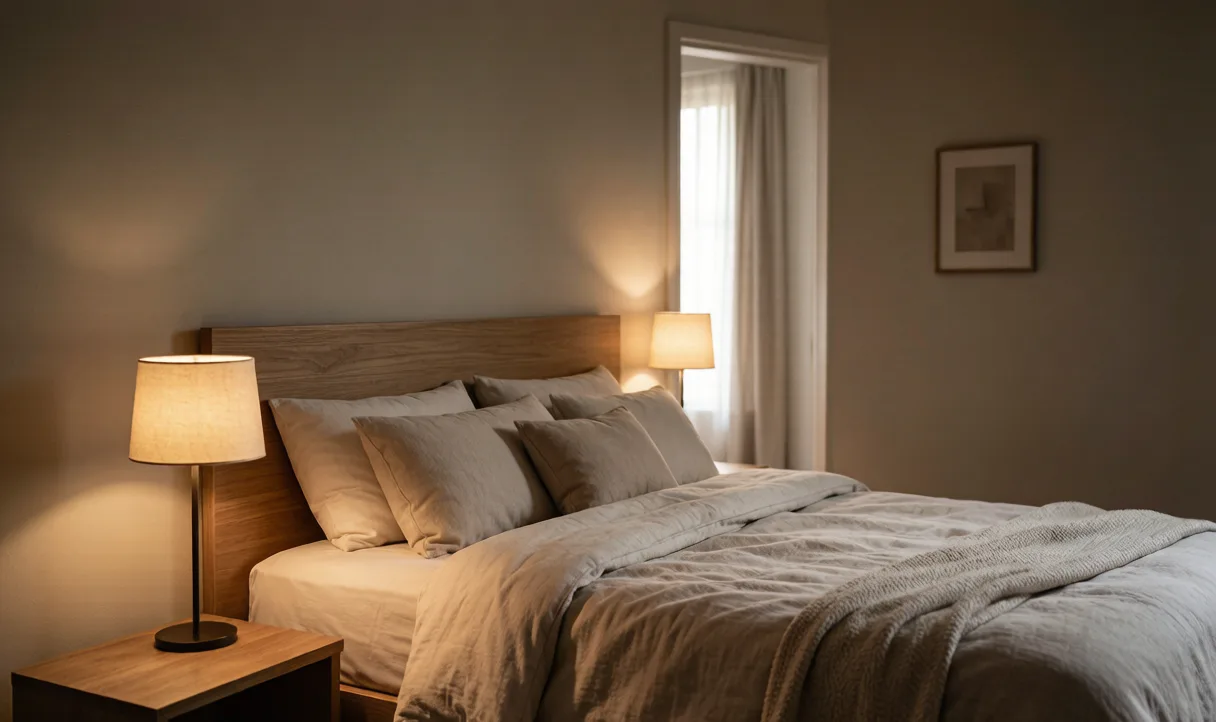
The command position is the load-bearing change. Head against a solid wall, a clear sightline to the door, the bed not in the doorway’s direct path. From there you stop listening for the hall.
A plain wood headboard helps even if it is just visual. The “no support” feel of a bed floating mid-room is real, and people sleep lighter there. Push it against something solid. If the frame has no headboard, a plain board or even a heavy bookshelf behind the pillows does the job.
The mirror out of the glass
At 3 a.m. you half-wake, catch movement in the glass, and your brain spikes with “who is that?” A cloth over the mirror, or turning it to the wall, removes the trigger. The mirror facing the bed is the most common sleep complaint I hear, and it is the cheapest to fix. The full read is in the mirror guide, but the cloth test is the fastest diagnosis. Cover it for a week and watch the rough nights.
The electronics off the wall
Electronics with standby lights belong in a drawer or off at the wall, because a blinking pixel pulls your eye even with the screen dark. Move the router, the charging brick, the cable box, the television remote. The bedroom is the one room in the house where you are not the room’s user. The room is yours, and the standby lights are not.
This is the fix most people skip because they do not see the wires as part of the room. They are. The eye picks them up at 3 a.m. whether the brain admits it or not.
The window dressed at night
A window at your back leaves you feeling exposed, because the glass is a thin boundary between you and the night outside. Heavy curtains drawn after dark, blackout if streetlight is the issue, thermal if the draft is. The full bed-under-window playbook is in the bed under window guide, but the principle is the same: headboard, curtain, seal.
Crack a window for ten minutes before bed. Stale air is heavy air, and a short fresh-air reset changes how you feel in the morning more than people expect.
The visible mess cleared
The visible mess matters more than people expect. Pillow piles and a laundry chair read as unfinished business, and your eye keeps tallying them after the light goes out. Ten minutes of clearing the surfaces you can see from the bed beats most gadgets. I tell clients to do this as a habit, not a deep clean. Make the room look done before you get in.
The sounds you have stopped hearing
A homeowner slept with the bed against the wall shared with the stairs, and never linked the 3 a.m. wakings to the footsteps above. We shifted the bed to the inner wall and the nights calmed. The point is that “feeling unsafe” is often a sound or a draft you have trained yourself to ignore. Walk the room at night, listen, and notice what your body already knows.
The fix is rarely the mattress. It is the boundary around it.
Color and the calm room
The eye reads the room before the body sleeps. A bedroom in loud, saturated color keeps the mind ticking, while soft, muted tones let it wind down. You do not need beige everywhere. You need a space that does not argue with you at lights out. A client swapped a bright accent wall for a dimmer shade and said the room finally felt like a place to rest, not a statement to admire. The color logic is in the feng shui colors bedroom guide.
The routine that seals it
The layout sets the stage, but the last ten minutes decide the night. Make the bed, clear the surfaces you see from the pillow, dim the lights a half hour before you lie down. A room that looks done tells your brain the day is. A client who added this habit after moving the bed said the two together did what neither did alone. The fixes above are the structure. The routine is what makes them stick.
A note on expectation
The rough nights rarely vanish on night one. The body takes a few cycles to trust the new setup. Give each fix a week before you judge it. If the 3 a.m. waking shortens, even by twenty minutes, the layout is moving in the right direction. You are not chasing a perfect sleep, just a calmer one.
Common Questions
Does bedroom layout really affect sleep?
Yes. The space shapes how safe and calm you feel, and that is half the battle. A bed with wall support and a door view helps you settle. The deeper read is in the bed placement guide.
Why should not a mirror face the bed?
At 3 a.m. you catch movement in the glass and your brain spikes with alarm. Cover it or turn it to the wall to remove the trigger. The full read is in the mirror guide.
What is the best bed position for sleep?
Head against a solid wall, able to see the door without lying in its line. That command position lets you relax instead of listening for the hall.
Do I have bad feng shui if I sleep fine?
The routine that seals it
The layout sets the stage, but the last ten minutes decide the night. Make the bed, clear the surfaces you see from the pillow, dim the lights a half hour before you lie down. A room that looks done tells your brain the day is. A client who added this habit after moving the bed said the two together did what neither did alone. The fixes above are the structure. The routine is what makes them stick.
A note on expectation
The rough nights rarely vanish on night one. The body takes a few cycles to trust the new setup. Give each fix a week before you judge it. If the 3 a.m. waking shortens, even by twenty minutes, the layout is moving in the right direction. You are not chasing a perfect sleep, just a calmer one.
Common Questions
Does bedroom layout really affect sleep?
Yes. The space shapes how safe and calm you feel, and that is half the battle. A bed with wall support and a door view helps you settle. The deeper read is in the bed placement guide.
Why should not a mirror face the bed?
At 3 a.m. you catch movement in the glass and your brain spikes with alarm. Cover it or turn it to the wall to remove the trigger. The full read is in the mirror guide.
What is the best bed position for sleep?
Head against a solid wall, able to see the door without lying in its line. That command position lets you relax instead of listening for the hall.
Do I have bad feng shui if I sleep fine?
Not at all. If you rest well, your layout is already working. The tips are for the nights you do not.
Is a bed under a window a problem?
It leaves your back to a thin boundary with the night, so you feel exposed. Move it to a solid wall if you can. A headboard and heavy curtain help if you cannot. The playbook is in the bed under window guide.
About the author
Sanhe (Guo Yutong) is the founder of Fengshuipower. Trained in classical feng shui, she reads floor plans and photos from anywhere in the world and sends a written plan you can act on. For the wider bedroom picture, the bedroom feng shui guide is the long version.
