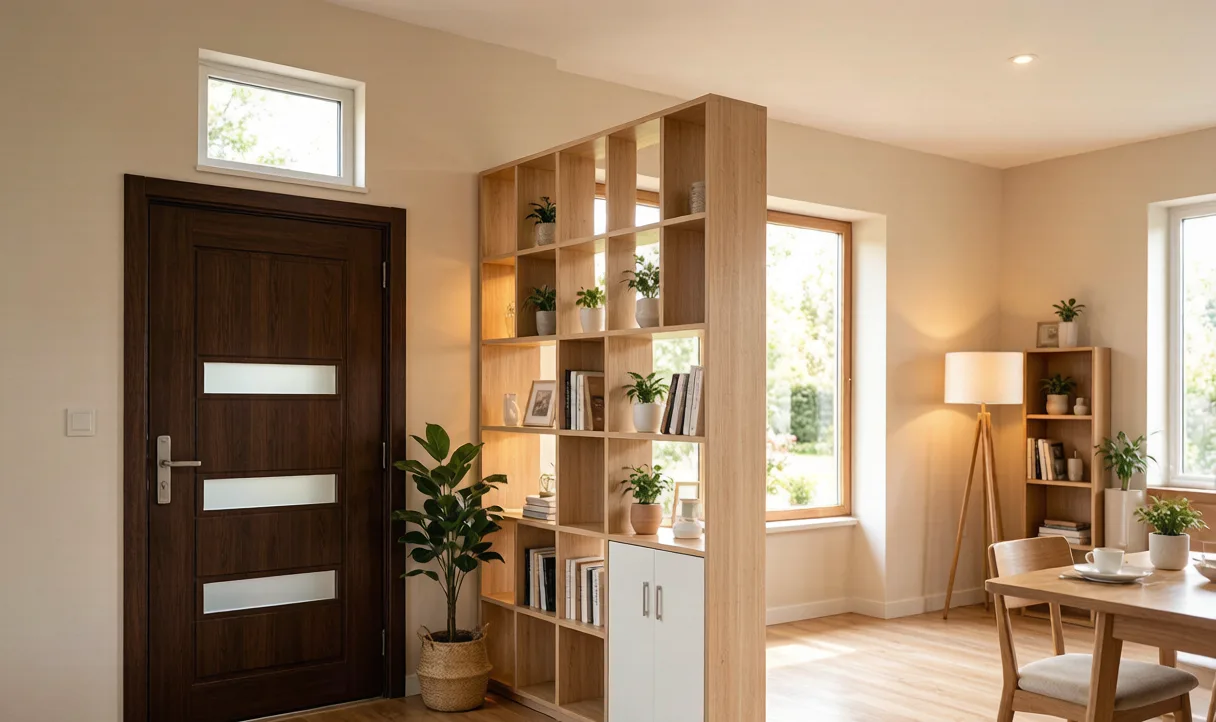

“You can see straight through the house from the front door to the back, so all your luck rushes out the back door.” That’s the belief a friend passed to a client of mine, and it’s the line most people Google before they call me. The worry is half-right, and the half that’s wrong is why so many good homes get needless panic.
A client in a lane house outside walked me from the front door straight to the back and stopped. “You can see right through,” she said. “A friend told me that’s bad. Is she right?”
Why the Straight Shot Feels Wrong
Front and back door alignment creates a “qi arrow”: energy enters and leaves without slowing to nourish the rooms in between. The home reads as a corridor instead of a place, and a corridor is somewhere you pass through, not somewhere you settle.
A home that’s a clean shot from front to back often feels drafty and unsettled. You walk in and the eye escapes out the back; nothing makes you want to stay. The rooms along the line get the least of the arriving energy because it never pauses to land in them.
This is the half-true part. The worry about “losing luck out the back” is a story wrapped around a real, physical feeling: a house that won’t hold you. The fix is to give the energy somewhere to rest, not to fear the back door.
Why People Feel It as Lost Money
The belief that luck “rushes out the back” comes from a real observation. When energy never pauses in the middle of the home, the rooms where a family actually lives and earns feel thin, and people read that thinness as money slipping through. It isn’t a curse on your income; it’s the home not holding the energy you bring in. Fix the pause and the feeling of scarcity lifts, which is why clients describe the change as the house finally keeping what they make.
When It Actually Matters, and When It Doesn’t
Not every see-through layout is a problem. A long, empty hallway with the back door at the far end is the classic trouble, because there is nothing to slow the line. But if there are rooms, a bathroom, or a lived-in space between the two doors, the energy already bends and settles as it passes. An open-plan home where you can see the garden through the back is usually fine, because the space between is full of life, not an empty tube. A front door lined up with a back window follows the same logic, because the eye still escapes; the cure is the same, a curtain or a plant at the glass.
The layouts I actually move on are the ones where the front and back doors line up with nothing between them, or where the back door is a window you never use and the line feels like a draft you can’t place. Severity tracks emptiness: the barer the run between the doors, the more the straight shot reads.
Break the Line
The fix is to bend the sightline. A console table, a bookshelf, a folding screen, or a tall plant placed between the two thresholds forces the eye, and the energy, to pause. You’re not blocking the path, you’re giving it somewhere to rest.
Soft furnishings help too: a rug that changes the floor underfoot, a lamp that pulls attention to a side wall, curtains on the back window you actually close at night. Each one tells the energy to linger instead of bolt. A beaded curtain or a small wind chime hung at the midpoint adds a
sound break; the chime rings when air moves through, which is a plain cue that the space is alive and not just a tunnel.
The Back Door Itself
While you’re breaking the line, don’t neglect the far end. A back door that’s dark, sticky, or piled with recycling reads as an exit, not a destination, and the house feels like it’s always trying to push you out the back. Keep it lit, oil the hinges, and give it something to look at, a small plant or a chair, so the eye lands instead of escaping. In a modern townhouse I read where a living room sat squarely between the two doors, the run was already broken by the life in the room, and the client needed no cure at all. The empty tube is the problem; a lived-in middle is the fix.
The Crystal Option
I’ll hang a faceted crystal midway where light scatters in every direction; it’s a clean visual break and looks fine. Whether or not you buy the crystal logic, the principle holds: interrupt the straight shot.
What I don’t do is treat the back door as the enemy. Keep it usable, lit, and clear like the front, so the far end of the house feels like a destination rather than an exit. A home that holds you at both ends is a home the energy stays in.
I’m the founder of Fengshui Power, trained in the Zhengyi Dao lineage and the Yang Gong school. I serve clients remotely, from anywhere,
through online BaZi readings and feng shui consultations done from your birth date and floor plan. More about my background. When you want the personal read, a consultation is how we begin.
Common Questions
Is a straight front-to-back layout bad?
Not doomed, but it lets energy rush through without nourishing the middle. If there’s nothing between the doors, break the sightline and the home feels calmer and more held.
What’s the easiest fix for door alignment?
A console, bookshelf, screen, or tall plant between the two doors. Any object that bends the straight view works, and a rug or lamp at the side does the same.
Does a crystal really help?
A faceted crystal midway scatters light and breaks the line; it looks fine and does the job. The principle, not the object, is what matters.
Should I worry if my home has this layout?
Only if the run between the doors is bare. The cures are cheap and reversible, so try them and see if the space feels more settled. There’s no
reason not to.
Related: Front door entryway Front Door Facing Window Feng Shui Front Yard Feng Shui Backyard Garden Feng Shui Feng Shui for Selling Your Home
