
By Sanhe
· Founder of Fengshuipower, trained in classical feng shui
· Published July 30, 2026
· ~13 min read
A client once described her living room as “the room where everyone ends up but nobody relaxes.” She had a sectional floating in the middle, the TV above the fireplace, and a mirror on the wall opposite the front door. Guests gravitated to the kitchen instead. We moved the sofa against the longest solid wall, turned it so it met the door at an angle rather than head-on, slid the mirror to a side wall, and took the TV down a foot. Two weeks later she sent a photo: people actually sitting, talking, not drifting off. Same furniture, same square footage. The room simply stopped working against the people in it.
I start there because living room feng shui is less about luck and more about whether a space invites a person to stay. The bedroom is a yin room, built for withdrawal. The living room is the opposite: a yang room, the place where the home meets the world. Get it right and guests settle, conversations start, and the room earns its keep. Get it wrong and people feel it before they can name it.
This is the long version. It works through the living room the way I work through it in a consult, from the sofa outward, and each section points to a deeper read on that subtopic.
In this guide
- What living room feng shui actually changes (and what it doesn’t)
- The sofa in command position
- When the sofa has no wall behind it
- Coffee tables, corners, and furniture hierarchy
- The front door sightline
- Mirrors: where they help and where they hurt
- The TV and the fireplace
- Color and the social eye
- Light, air, and plants
- The wealth corner
- Beams, low ceilings, and awkward shapes
- Art and decor that helps
- The small living room
- Common questions (real ones people ask)
- Continue reading: cluster pages
What living room feng shui actually changes (and what it doesn’t)
Most of the anxiety around this topic comes from people expecting it to do something it can’t. Living room feng shui is the practice of arranging the room so people feel welcomed, calm, and inclined to stay. That is the whole of it. It is not a wealth spell, not a personality fix, and not a substitute for a bigger apartment.
What it does well is small and repeatable. It moves a sofa so the person on it has something solid at their back. It slows energy that would otherwise rush from the front door straight out the balcony. It clears a path so the room can be walked through without dodging a coffee table. None of this pays your bills or fixes a difficult relative. All of it makes the room a place people choose to be in, and that choice shows up in how your evenings feel.
If you are skeptical, that is fine. A room quietly rewards what soothes and quietly punishes what nags, and that holds whether or not you ever use the word qi. The rest of this guide is about what soothes and what nags, with as little mysticism as I can manage.
The sofa in command position
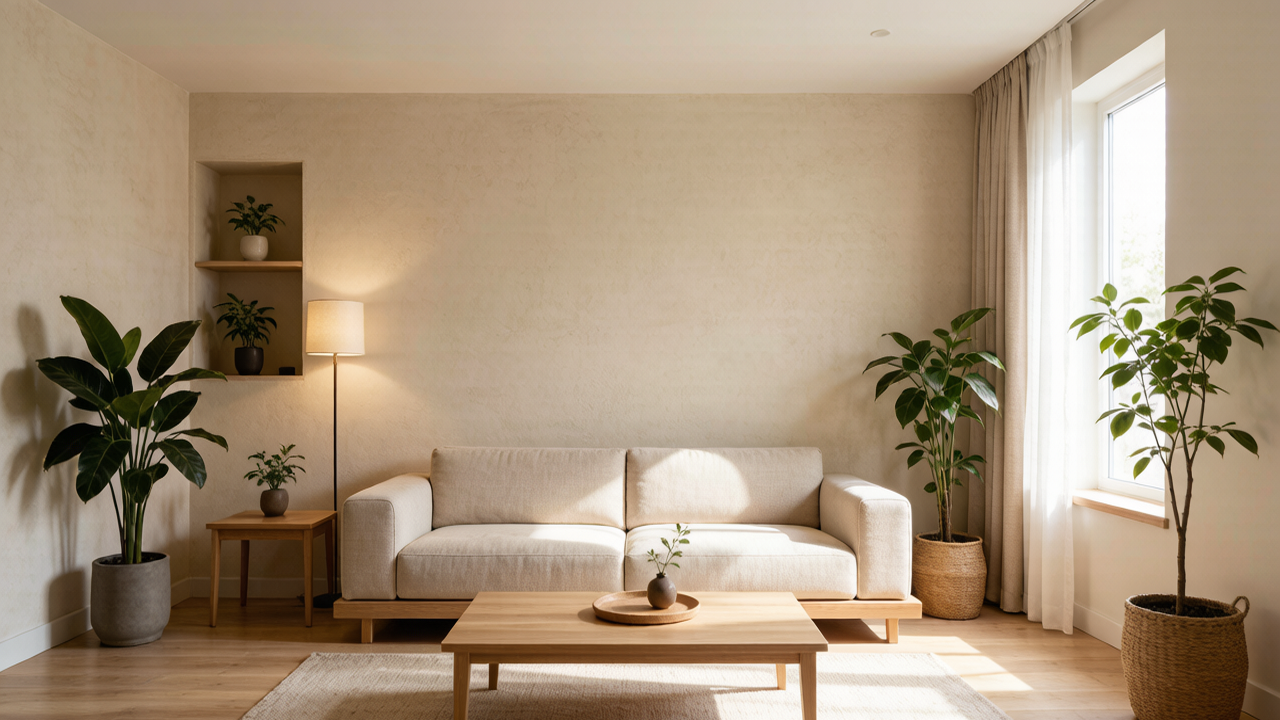
The sofa is the anchor of the living room, so it gets the same principle the bed gets in the bedroom: command position. The main seating sits against a solid wall, with a clear sightline to the front door, but not lined up directly in the doorway’s path. You can see who comes in without sitting in the doorway’s line of fire.
A solid wall behind the sofa is what practitioners call mountain at your back — the kind of support you feel in your body. The person sitting there is not exposed, not wired to glance over a shoulder, not braced for whoever walks in. Even clients who roll their eyes at the concept report the same thing once it is done: the room feels steadier.
Three smaller points ride along:
- Avoid the sofa directly facing the front door. Sitting in the door’s direct line means every arrival hits you head-on. Angle the sofa a quarter turn, or put a console table or screen between you and the door.
- Leave the path around it open. A sofa you have to step over to reach the window turns the room into an obstacle course. Keep at least three feet of clear walking room.
- Face the seating inward, toward each other. A U-shape or an L-shape that wraps the coffee table invites conversation. Two sofas back-to-back, or chairs staring at a wall, do the opposite.
When the room gives you a weird shape, a beam, or no free wall, the sofa placement guide walks through each case with a photo and a one-week test.
When the sofa has no wall behind it
Rentals and open-plan homes love to leave the sofa stranded in the middle of the floor. No wall behind it, nothing at its back, the person sitting there exposed on three sides. This is the single most common living-room complaint I hear, and the fix is almost always a virtual wall rather than a move you cannot make.
Three stand-ins work, alone or together:
- A console table behind the sofa. Even a low one gives the eye something solid at the back. Put a lamp and a plant on it and the sofa stops feeling adrift.
- Tall plants. A fiddle leaf fig or a bamboo palm in a floor pot works like a soft wall and adds life to the corner.
- A low bookshelf or room divider. Closed storage doubles as backing and hides the remotes.
The point is not the object. The point is that the person sitting there no longer feels like the back of the room is open and watching. One client with a studio apartment built a virtual wall from a bookshelf and said she finally “stopped sleeping with one ear out” even though the sofa was nowhere near her bed. The living room and the sleep are connected more than people expect.
The full virtual-wall playbook, including the renter-friendly version when nothing can move, is in the sofa placement guide.
Coffee tables, corners, and furniture hierarchy
The coffee table sits in front of the sofa and should stay below it. In the old framework the sofa is the mountain and the table is the water: the mountain stays higher. A coffee table that rises above the sofa seat sends the wrong signal, and people describe the room as pressuring or stuck without knowing why.
Two rules cover most of it:
- Keep the table lower than the sofa seat. Knee height or just below the armrest is the target. If yours is taller, swap it.
- Soften the corners. Rectangular tables with sharp corners point cutting energy at anyone sitting in their line. Round or oval tables remove the problem entirely. If you love a square table, pad the corners or set a low plant at each point.
The hierarchy extends to the room. Heavy, tall storage belongs against walls, not blocking the walking path. A room where every piece has a clear role feels calm; a room where furniture competes for the center feels noisy. The sofa placement guide covers the proportion rules in detail.
The front door sightline
Stand outside your own front door and look in. If your eye runs straight from the door through the living room and out a window or balcony, that is the sightline to soften. Energy that rushes in and straight out is said to carry opportunity with it, and the practical version is simpler: a room you can see through in one glance feels like a corridor, not a destination.
The fix is to slow the handoff, not block it:
- A folding screen or a console table between the door and the window.
- A large plant in the sightline, far enough from the glass to read as a stop.
- A heavy curtain on the window you can draw partway.
A related case is the door opening straight onto the sofa. We covered that above. The closed-door-at-night habit that helps the bedroom does not apply here, but a sightline that does not shoot across the whole room helps the living room just as much. The mistakes guide maps the five sightline errors and the cheapest fix for each.
Mirrors: where they help and where they hurt
Mirrors are the most misused tool in the living room. Used well they borrow light and make a small room feel larger. Used carelessly they push energy out the door or reflect people in a way that feels like being watched.
Three placements cause almost every problem:
- Mirror directly opposite the front door. This is the big one people have heard of. A mirror facing the door reflects arriving energy straight back out, so the room never quite receives it. Move the mirror to a side wall beside the door.
- Mirror facing the sofa. A mirror aimed at where people sit reflects them while they relax, and guests describe feeling observed. Angle it to catch a plant or a window instead.
- Mirror behind the sofa. Less common in the West but worth naming: a mirror at the sitter’s back carries the same exposed feeling as no wall at all.
Where mirrors help: on a side wall that catches natural light, in a narrow room to open it visually, or opposite a piece of art you want to double. The deeper read, including the renter-friendly versions when the mirror cannot move, is in the living room mirror guide.
The TV and the fireplace
The TV is the one object clients most resist moving, and the fireplace is the one they most resist questioning. Both are workable.
The TV above the fireplace is the layout I get asked about most. It is not forbidden. It is just high, which means necks crank up during a movie. If that is your only wall, mount it as low as the fireplace allows, pull the seating back so the angle is gentle, and keep the screen dark when no one is watching so it is not a glowing rectangle dominating the room. A TV that stays lit in a quiet room keeps the space awake.
The TV and the sofa relationship matters more than the wall. The screen should face the main seating, not sit beside it where everyone watches at an angle. Keep a comfortable distance: too close strains the eyes and crowds the energy; too far and the room splits into two zones that never meet.
For the fireplace, treat the open hearth as the room’s warm heart in winter and a dark cavity in summer. A seasonal screen or a planted arrangement in the off-season keeps it from reading as a hole. The TV placement guide covers the distance math and the fireplace workarounds.
Color and the social eye
The living room is a yang space, so it can carry more color and more light than a bedroom. A living room in heavy, dark, saturated color can feel like a cave; a living room in flat, lifeless beige can feel like a waiting room. The aim is a space that wakes up without shouting.
The five elements give a loose map. Wood is green and brown, growth. Fire is red and orange, warmth and talk. Earth is beige and yellow, steadiness. Metal is white and grey, clarity. Water is blue and black, stillness. Notice which energy the room is missing, then add a little.
For most living rooms, the safest base is warm and light: soft beige, warm white, a muted green, a dusty blue. Use red and orange as accents, not walls, unless the room is large and the seating is far from the paint. The one move that saves regret is to paint one wall and live with it a week before committing to the whole room. The color you stop noticing is the one doing its job.
The color logic goes room by room in the colors guide, including the warm-beige-versus-grey-beige trap and what to do once you have painted the wrong shade.
Light, air, and plants
A dark living room drains faster than almost anything else. Yang energy needs light. Start with what the room already has: open the curtains during the day, clean the windows, and let the sunlight in. Then layer: an overhead fixture for general light, a floor lamp for a reading corner, a table lamp on the console behind the sofa. Warm bulbs around 2700 to 3000 Kelvin copy daylight without the harshness.
Air matters as much as light. A room that never gets fresh air collects a heaviness you can feel by the third evening. Crack a window for ten minutes a day, even in winter. The room resets.
Plants are the easiest yang boost. A healthy money tree or a peace lily in the wealth corner, a pothos on the console, a tall plant behind the sofa as a virtual wall. Skip the spiky cactus in the main seating area and skip anything dying. A withering plant in the room you show guests looks like neglect you chose. The colors guide and the mistakes guide both cover plant placement in more detail.
The wealth corner
Every living room has a wealth area, usually the far diagonal corner from the front door. It is treated as the spot where settled, circulating energy gathers. The rules are simple and practical:
- Keep it clear. No stacked mail, no dead treadmill, no bulky storage pressing down on the corner.
- Keep it lit. A lamp or a well-lit plant tells the corner it is in use.
- Keep it alive. A healthy plant or a small, meaningful object. Not a broken fountain, not a dusty figurine.
What to avoid is easier to remember than what to add: no clutter, no darkness, no heavy weight on top. If the diagonal corner happens to be where your TV sits, that is fine. The principle is about the feeling of the corner, not a superstition about a square foot of floor. The wealth guide covers the bagua version and the renter-friendly version when the corner is a hallway.
Beams, low ceilings, and awkward shapes
A beam across the ceiling above the sofa does the same thing a beam over a bed does: the eye goes up, a corner of the mind stays mildly alert. The fix is reversible. Move the seating so the beam runs along the side rather than across the chest, paint the beam the ceiling color so it stops standing out, or hang a light fixture that draws the eye elsewhere.
Low and slanted ceilings press in a way people feel without naming. If the living room has one, keep the seating out of the lowest part, use vertical elements like floor lamps and tall plants to draw the eye up and out, and avoid heavy overhead lighting in the low zone. High ceilings are the opposite problem: the room can feel empty. Anchor it with a large rug and a substantial sofa so the space feels gathered rather than lost.
Odd shapes, L-plans, and narrow rooms each get their own fix in the small living room guide and the mistakes guide. The theme is always the same: define a clear seating zone so the room feels like one place, not three competing ones.
Art and decor that helps
The art on the wall sets the room’s emotional tone faster than the furniture. Serene landscapes, gentle botanicals, and calm abstract work. Aggressive animals, weapons, and chaotic imagery tend to feel harsh in a room built for ease. If you love a strong piece, the old rule is to turn the animal’s head toward the door so it guards the home rather than facing inward at the family.
Crystals and meaningful objects are fine and common: a piece of amethyst for calm, a small bowl that means something to you, a photo that makes you smile. The trap is clutter. A shelf of twenty objects is just noise; three objects you love signals intention. Let the decor tell a story instead of filling a surface.
The mistakes guide lists the decor errors that show up most, including the mismatched-furniture-styles problem and how to pull a room back to coherence.
The small living room
Small spaces punish clutter twice as hard, because every item carries more visual weight. The rules are the same as a large room, just applied at higher resolution.
- Clear the path first. If you can only do one thing, keep the walking route open and the surfaces clear.
- One mirror, placed well. A mirror on a side wall that catches light opens the room. A mirror opposite the door or the sofa works against you.
- Light, not dark, colors. They make the walls recede.
- One substantial sofa beats two small ones. A room with one clear anchor feels larger than a room crowded with small pieces.
A small living room is not a smaller version of the same rules. It is the same rules with less margin for error. The full small-room playbook, including the long narrow room and the open-plan studio, is in the small living room guide.
A short list of when to stop reading
Living room feng shui is not a project to finish. It is a set of habits to keep. Stop reading when the sofa has a solid wall at its back, the door sightline is softened, the mirror is not aimed at the door or the seating, the surfaces are clear, and the room feels good to walk into. Most clients hit that point inside two weeks of small moves. If the room still nags, the next layer is the routine — a switched-off TV, a lit corner, fresh air each day — and then, only if you want it, the deeper reads on the cluster pages below.
If you want a practitioner to read your specific room, your floor plan, your sofa, your door, your mirror, and the rest of the layout, that is what a consultation is for. I work with clients worldwide, entirely online, and the first read is usually the one that catches the issue no list of rules could have predicted.
Common questions
These are real questions people ask about their living rooms. I have cleaned up the grammar and put the practitioner’s answer underneath. The full context for each one is in the cluster pages linked above.
Is it bad to have the TV above the fireplace?
Not forbidden, just awkward. The main issue is height: a screen mounted over a fireplace sits high, so necks crane during a long watch. If that is your only wall, mount it as low as the fireplace allows, pull the seating back so the viewing angle is gentle, and switch the screen off when no one is watching so it is not a lit rectangle dominating the quiet room. The TV placement guide covers the distance math.
My sofa has to go in the middle of the room with no wall behind it. Is that bad?
It feels exposed, and most people relax less there even in a large room. The fix is almost always a virtual wall: a console table behind the sofa, tall plants, or a low bookshelf. Give the person sitting there something solid at the back and the room settles. The sofa placement guide walks through the renter-friendly versions.
Where should the sofa face in the living room?
Toward the room, with a clear sightline to the front door but not lined up directly in the door’s path. Angle it a quarter turn if the door is straight ahead. The goal is to see who arrives without sitting in the doorway’s line of fire. Facing the seating inward, toward each other, invites conversation more than facing a wall.
Is a mirror facing the front door really bad?
It is the placement people have heard of for a reason. A mirror opposite the door reflects arriving energy straight back out, so the room never quite receives it. Move the mirror to a side wall beside the door, where it can still borrow light without pushing energy out. The mirror guide covers the other two problem spots: facing the sofa and behind the sofa.
Which direction should my living room face for good feng shui?
The traditional preference is a living room toward the front or center of the home, welcoming rather than buried deep. Beyond that, direction matters less than the room’s actual feel: light, open paths, a solid wall behind the main seating. If your living room sits at the back, warm light and a clear sightline from the door do most of the work. The facing direction guide covers the compass version.
My living room is long and narrow. How do I arrange it?
Define two or three clear zones instead of one thin corridor. Put the main seating at one end against the widest wall, the TV or a console at the other, and a slim console or a row of plants along the long side to break the tunnel feel. Keep the walking path down the center open. The small living room guide has the long-room layout.
What color should I paint my living room?
Warm and light as a base: soft beige, warm white, a muted green, a dusty blue. Use red and orange as accents, not full walls, unless the room is large. Paint one wall first, live with it a week, then commit. The color you forget is the one working. The colors guide goes room by room.
I have a beam across the ceiling above my sofa. What do I do?
Move the seating so the beam runs along your side instead of across the chest, paint the beam the ceiling color, or hang a light fixture that pulls the eye elsewhere. None of these require construction. If the beam is the real problem, the three-night test in the mistakes guide tells you.
My front door lines up with the balcony window. Is that losing money?
The practical version: energy rushes from the door straight out the window, so the room never settles. Slow it with a screen, a console table, or a large plant in the sightline. You are not losing money in any literal sense, but a room you can see through in one glance does feel like a corridor. The fix is cheap and worth doing.
My living room is tiny. Can feng shui still help?
More than you think, and almost none of it needs a renovation. Clear the path, keep surfaces bare, place one well-chosen mirror to borrow light, and use light colors so the walls recede. A small room is the same rules at higher resolution. The small living room guide is the read.
About the author
Sanhe (also known as Guo Yutong) is the founder of Fengshuipower. Trained in classical feng shui, she works with clients worldwide through online consultation reports, reading floor plans, photos, and BaZi charts from anywhere. Her approach borrows the rigor of the old texts and leaves the folklore at the door. She writes the practical guides on this site.
If you want a practitioner to read your specific room, a Fengshuipower consultation walks through your floor plan, your sofa, your door, your mirror, and the rest of the layout, in that order, and ends with a written plan you can act on.
