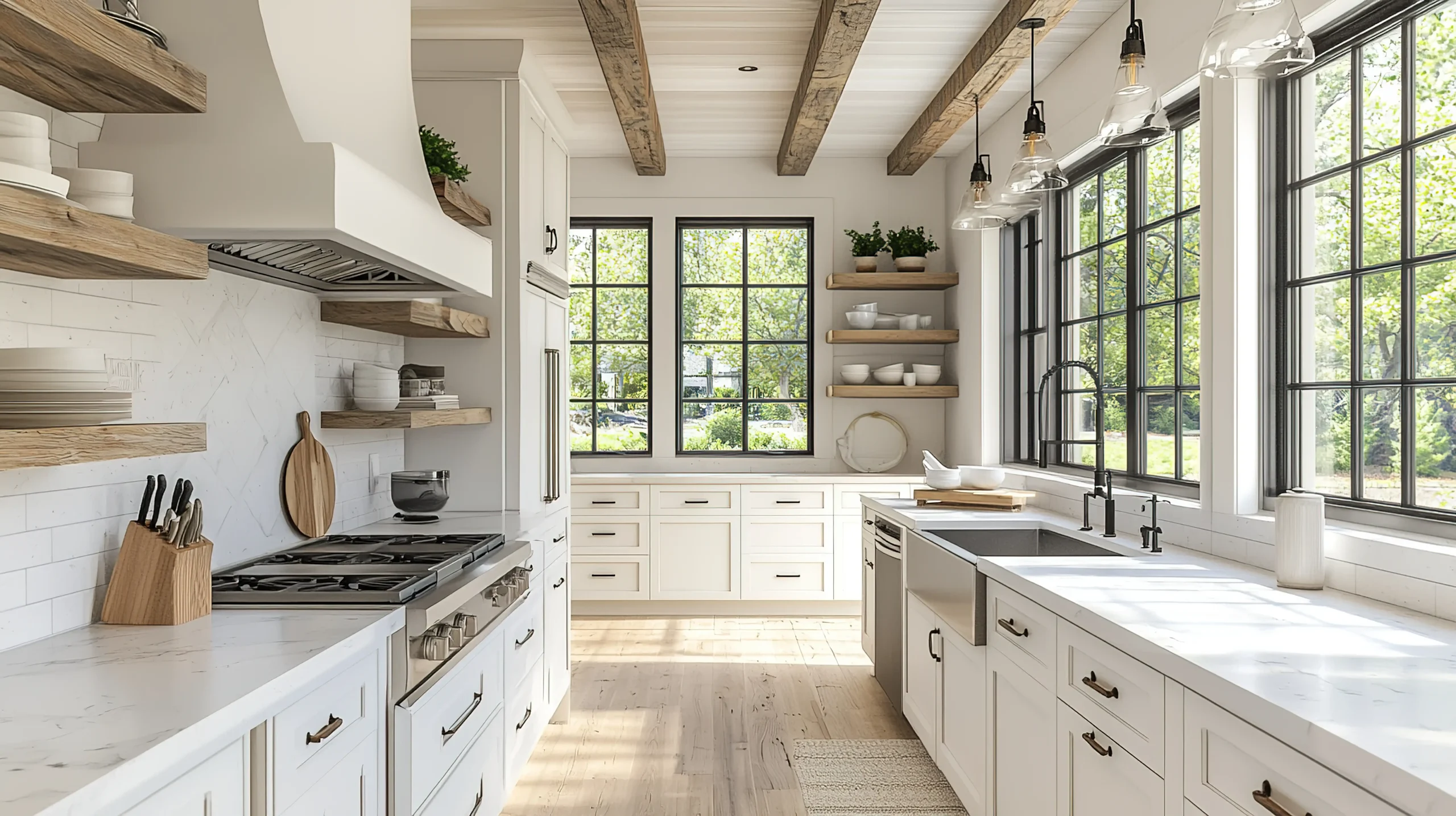

By Sanhe· Founder of Fengshuipower, trained in classical feng shui · Published July 20, 2026 · ~13 min read
A couple came to me because their kitchen, by every normal measure, was fine. New cabinets, good light, plenty of counter. But they argued there more than anywhere else in the house, and the wife told me she hated cooking in it without being able to say why. I stood at the stove and looked back. The sink sat directly across from the burners, the fridge was three feet to the left, and the cook had her back to the door every time she stirred a pot. We did not move a wall. We shifted the cutting board between the sink and the stove, turned the nearest stool so the cook could see the doorway in its reflection, and hung a solid board on the wall behind the stove. Six weeks later she wrote that dinner felt calm now. Same kitchen. The conflict between the elements, and the cook with no sight of the room, had been the quiet third person at every meal.
I start there because kitchen feng shui is less mystical than it sounds and more practical than people expect. The kitchen is the room where the household is literally fed, and the stove is treated as the source of the home’s nourishment and stability. Get the basics right and the room supports the people in it. Get them wrong and the room works against you in small, daily ways you stop noticing.
This is the long version. It moves through the kitchen the way I do in a consult, from the stove outward, and each section points to a deeper read on that subtopic.
In this guide
- What kitchen feng shui actually changes (and what it doesn’t)
- The stove in command position
- A solid wall behind the stove
- The sink and the stove: keeping water and fire apart
- The stove facing the door or the window
- The kitchen facing the front door (开门见灶)
- The kitchen in the center of the home
- The refrigerator and the microwave
- Color and the five elements
- Light, air, and living things
- Clutter, the bin, and the counters
- The dining corner
- The small kitchen
- Common questions (real ones people ask)
- Continue reading: cluster pages
What kitchen feng shui actually changes (and what it doesn’t)
Most of the worry around this room comes from people expecting it to do something it cannot. Kitchen feng shui is the practice of arranging the room so the act of feeding a household feels steady, safe, and unhurried. That is the whole of it. It is not a wealth spell, not a cure for a tight budget, and not a replacement for a better floor plan.
What it does well is concrete. It moves the stove so the person cooking has something solid at their back. It separates the sink from the burners so water and fire are not in a straight fight. It slows the sightline from the front door so the room is not a corridor the energy blows through. None of this pays a bill or fixes a difficult relationship. All of it changes how the room feels when you stand in it at the end of a long day, and that feeling is the part worth having.
If you are skeptical, that is reasonable. A kitchen quietly rewards what is calm and quietly punishes what is rushed, and that holds whether or not you use the word qi. The rest of this guide is about the calm and the rushed, with as little folklore as I can manage.
The stove in command position
The stove is the anchor of the kitchen, so it gets the same principle the bed and the sofa get: command position. The person cooking has a clear view of the room and the door, with something solid at their back, and is not lined up directly in the doorway’s path. You can see who comes in without standing in the doorway’s line of fire.
In the old framework the stove is the mouth of the home’s wealth, because it is where nourishment is made. The practical version is simpler: a cook who can see the room cooks with less tension, and a room where the cook is at ease feeds people more comfortably. A stove tucked under a window or stranded on an island with the cook’s back to the room reverses that.
Three smaller points ride along:
- Avoid the stove directly facing the kitchen door. Energy rushes in and out without settling, and the cook feels exposed. Angle the stove a quarter turn, or put a tall cabinet or a plant between the stove and the door.
- Keep the path around it open. A stove you have to reach past a chair to use turns the room into an obstacle course. Keep at least three feet of clear walking room.
- Face the cook inward, toward the room. A stove pushed into a corner that faces a wall keeps the cook isolated from the people they are feeding. Turn it so the cook is part of the room.
When the room gives you a weird shape, a window behind the stove, or no free wall, the stove placement guide walks through each case with a photo and a one-week test.
A solid wall behind the stove
A stove with a wall behind it is what practitioners call mountain at your back. That is support you can feel. The person cooking is not exposed, not braced for whoever walks in, not half-watching the doorway over a shoulder. Even clients who roll their eyes at the concept report the same thing once it is done: the room feels steadier.
Rentals and open-plan homes love a stove on an island, with the cook facing the living room and nothing at their back. This is the single most common kitchen complaint I hear, and the fix is almost always a visual wall rather than a move you cannot make.
Three stand-ins work, alone or together:
- A solid backsplash or board on the wall behind. Even a panel of wood or a row of open shelving with solid objects gives the eye something at the back.
- A tall cabinet or a fridge on the side. Positioned so the cook’s back is not open to the room.
- A mirror or reflective surface set so the cook can see the door behind them. This is the oldest fix in the book, and it works because the cook is no longer blind to the room.
The full playbook, including the renter-friendly version when nothing can move, is in the stove placement guide.
The sink and the stove: keeping water and fire apart
The sink and the stove are the one relationship in the kitchen that earns the most attention, and for good reason. The stove is fire. The sink, the dishwasher, and the fridge are water. Put them in a straight fight and the room feels split, two things pulling against each other.
The rule is straightforward:
- Do not put the sink directly opposite the stove. Water faces fire, and the people in the room describe it as more arguments and a shorter fuse, whether or not they know why.
- Do not put the sink directly beside the stove with no buffer. Side by side is less of a clash than face to face, but a cutting board or a low plant between them takes the edge off.
- Watch the faucet direction. A tap that points straight at the burners creates the same pull even if the sink is diagonal. Most modern taps swivel, so angle it away.
Where there is no way to separate them in a small kitchen, the sink and stove guide covers the wood-element buffer (a cutting board, a herb pot, a strip of green) that sits between the two and lets them coexist. The point is not superstition about elements. It is that a cook working between a rushing tap and a roaring burner is working in two competing pulls, and the meal absorbs that.
The stove facing the door or the window
Two placements cause almost every stove problem.
The stove facing the kitchen door. When the burners line up with the doorway, the energy of the room runs straight in and straight out without settling. The cook also has their back to the room. The fix is a visual stop: a tall cabinet, a plant, or a partial screen between the stove and the door.
The stove under a window. A window behind or above the stove lets the heat and the feeling of the room escape. Practically, a draft cools the food and distracts the cook. The fix is soft: a curtain you can draw, a plant on the sill, or simply keeping the stove anchored against a solid wall and letting the window sit to the side instead.
A related case is the stove visible from the front door of the house, which is its own problem covered next. The closed-door habit that helps the bedroom does not apply here. A kitchen door left open is fine. What matters is that the stove is not in a direct line from the entrance. The deeper read, including the beam-above-the-stove problem, is in the stove placement guide.
The kitchen facing the front door (开门见灶)
This is the layout people have heard of, and it is worth naming plainly. When you open the front door of the house and the stove is the first thing you see, the old texts call it opening the door onto the stove. The practical version is that the energy of the home, and the eye of every guest, lands straight on the fire. The room never settles, and the feeling is of wealth coming in and leaving at once.
The fix is to slow the handoff, not block it:
- A screen, a bookshelf, or a console table between the front door and the kitchen.
- A partial wall or a tall plant that breaks the direct line of sight.
- Keeping the kitchen door closed when the stove is in view (a small habit, a real effect).
A client with exactly this layout refused to move the stove (a rental, fixed plumbing) and instead set a slim bookshelf in the entry path. She said guests stopped walking straight to the kitchen and the room felt like it had a beginning. The facing-the-front-door guide maps the five versions of this problem and the cheapest fix for each.
The kitchen in the center of the home
The center of a home is its calmest point, the place energy gathers and rests. A kitchen there loads that center with fire, noise, and the constant movement of cooking. The room never quiets, and the home stays restless.
If your kitchen sits in the middle of the plan, you have options short of renovation:
- Soften the fire. Use earth tones (beige, sand, a muted clay) rather than red or black on the walls and the cabinets.
- Keep it clean and closed. A cluttered center spreads the restlessness to the whole home. Closed storage helps.
- Quiet the appliances. A vent that hums all evening keeps the center awake. Run it, then let the room go still.
What to avoid is easier to remember than what to add: no bold red, no open shelving packed with stuff, no stove left visibly glowing into the living space. If the center kitchen is fixed, the center-of-house guide covers the renter-friendly version, including how to draw the eye away from the stove.
The refrigerator and the microwave
The fridge is water, like the sink, so the same water-fire care applies. A fridge directly beside the stove creates the same low-grade clash as a sink beside it. A cutting board or a herb pot between them is the usual fix.
The microwave is a smaller fire, and people forget it. A microwave above the stove, common in small kitchens, stacks two fires and crowds the cook. If you can, move it to a side wall or a lower cabinet. If you cannot, keep it closed when not in use so it is not a second glowing eye above the burners.
Both appliances matter less than the stove, but they are part of the room’s balance. The sink and stove guide includes the appliance triangle (stove, sink, fridge) and why a loose triangle beats a tight line.
Color and the five elements
The kitchen carries more fire than any other room, so color does real work. A kitchen in heavy red can feel like the heat is turned up even when it is not. A kitchen in flat white can feel like a clinic. The aim is a space that cooks in without shouting.
The five elements give a loose map. Wood is green and brown, growth. Fire is red and orange, warmth. Earth is beige and yellow, steadiness. Metal is white and grey, clarity. Water is blue and black, stillness. Notice which energy the room is missing, then add a little.
For most kitchens, the safest base is warm and light: soft beige, warm white, a muted green, a dusty blue. Use red and orange as accents, not walls, unless the room is large. The one move that saves regret is to paint one wall and live with it a week before committing to the whole room. The color you stop noticing is the one doing its job.
The color logic goes room by room in the colors guide, including the red-versus-earth trap and what to do once you have painted the wrong shade.
Light, air, and living things
A dark kitchen drains faster than almost anything else. Fire energy needs light to feel alive. Start with what the room already has: open the curtains during the day, clean the window, let the sunlight in. Then layer: an overhead fixture for general light, under-cabinet strips for the counter, a small lamp if the room allows. Warm bulbs around 2700 to 3000 Kelvin copy daylight without the harshness.
Air matters as much as light. A kitchen that never gets fresh air collects a heaviness, and the smell of last night’s dinner is still there at breakfast. Crack a window while you cook, even in winter. The room resets. (For the indoor-air side of why ventilation matters, the EPA’s indoor air quality basics are a plain-English reference.)
Plants are the easiest life boost. A pot of basil on the windowsill, a small plant on the counter, herbs within reach of the stove. Skip anything dying, and skip the spiky cactus near where people eat. A withering plant in the room you feed the family looks like neglect you chose. The colors guide and the mistakes guide both cover plant placement in more detail.
Clutter, the bin, and the counters
The counters are where the room’s calm is won or lost. A counter packed with appliances, mail, and yesterday’s dishes makes the room feel like it never finishes. Clear the main stretch you cook on, and keep the rest light.
The bin is the one object worth a word. A bin in full view, open or not, is a visible drain. Tuck it in a cabinet or a closed pull-out. Empty it often. Clients are surprised how much calmer the room feels when the bin is out of sight.
Two rules cover most of it:
- Keep the counters you cook on clear. One appliance out is fine. Five is a crowd.
- Close the storage. Open shelving packed with stuff spreads the noise. Closed doors quiet the room.
The mistakes guide lists the ten errors that show up most, including the stacked-mail trap and the fridge-covered-in-paper problem.
The dining corner
The kitchen often flows into where the household eats, and that corner deserves the same care. The table sits away from the stove, not jammed against it, so the act of eating is separate from the act of cooking. A table with a clear view of the room, not pushed into a wall with everyone’s backs to the door, makes the meal feel like an event rather than a refuel.
A odd shape, a narrow nook, or an open-plan island each get their own fix in the small kitchen guide and the mistakes guide. The theme is always the same: define a clear place to sit so the room feels like one home, not three competing ones.
The small kitchen
Small kitchens punish clutter twice as hard, because every item carries more visual weight. The rules are the same as a large room, just applied at higher resolution.
- Clear the path first. If you can only do one thing, keep the walking route open and the surfaces clear.
- One mirror, placed well. A mirror on a side wall that catches light opens the room. A mirror opposite the stove works against you.
- Light, not dark, colors. They make the walls recede.
- One substantial work zone beats three small ones. A room with one clear counter feels larger than a room broken into scraps.
A small kitchen is not a smaller version of the same rules. It is the same rules with less margin for error. The full small-room playbook, including the galley and the studio kitchenette, is in the small kitchen guide.
A short list of when to stop reading
Kitchen feng shui is not a project to finish. It is a set of habits to keep. Stop reading when the stove has a solid wall at its back, the sink is not in a straight fight with the burners, the cook can see the door, the counters are clear, and the room feels good to stand in. Most clients hit that point inside two weeks of small moves. If the room still nags, the next layer is the routine: a switched-off vent, a lit corner, fresh air each day. And then, only if you want it, the deeper reads on the cluster pages below.
If you want a practitioner to read your specific kitchen, your floor plan, your stove, your sink, your door, and the rest of the layout, that is what a consultation is for. I work with clients worldwide, entirely online, and the first read is usually the one that catches the issue no list of rules could have predicted.
Common questions
These are real questions people ask about their kitchens. I have cleaned up the grammar and put the practitioner’s answer underneath. The full context for each one is in the cluster pages linked above.
Should the stove face the kitchen door?
No. A stove in a direct line with the door lets energy rush in and out without settling, and the cook works with their back to the room. Angle the stove a quarter turn or put a tall cabinet, a plant, or a screen between the stove and the door so the cook can see who comes in.
Is it bad to have the sink opposite the stove?
It is the most common water-fire clash in a kitchen. The sink, dishwasher, and fridge are water; the stove is fire. Put them directly opposite and the room feels split, two things pulling against each other, and people describe more arguments and a shorter fuse. A cutting board or a herb pot between them takes the edge off, and the sink and stove guide covers the small-kitchen version.
My kitchen is right by the front door. Is that bad?
If you open the front door and see the stove first, that is the layout called opening the door onto the stove. The fix is to slow the sightline, not block it: a screen, a bookshelf, or a plant between the door and the kitchen, or simply keeping the kitchen door closed. The facing-the-front-door guide maps the five versions and the cheapest fix for each.
Can the kitchen be in the middle of the house?
It can, but a center kitchen loads the calmest point of the home with fire and noise. Soften it with earth tones rather than red, keep it clean and closed, and quiet the appliances when they are not running. The center-of-house guide covers the renter-friendly version.
Which direction should the stove face?
The traditional preference is a stove that faces one of the supportive directions for the home’s occupants, often east or southeast where wood feeds fire. More than direction, the room’s actual feel matters: a solid wall behind, a clear view of the door, no window at the cook’s back. The stove placement guide covers the direction version.
What color should I paint my kitchen?
Warm and light as a base: soft beige, warm white, a muted green, a dusty blue. Use red and orange as accents, not full walls, unless the room is large. Paint one wall first, live with it a week, then commit. The color you forget is the one working. The colors guide goes room by room.
Is a stove under a window bad?
It lets heat and the feeling of the room escape, and a draft cools the food and distracts the cook. The fix is soft: a curtain you can draw, a plant on the sill, or simply keeping the stove against a solid wall with the window to the side. The stove placement guide has the details.
Does the refrigerator placement matter?
Yes, but less than the stove. The fridge is water, so keep it from sitting directly beside the burners, and put a cutting board or a herb pot between them if they must be close. A loose triangle of stove, sink, and fridge works better than a tight line. The sink and stove guide covers the triangle.
My kitchen is tiny. Can feng shui still help?
More than you think, and almost none of it needs renovation. Clear the path, keep the counters bare, place one well-chosen mirror to borrow light, and use light colors so the walls recede. A small room is the same rules at higher resolution. The small kitchen guide is the read.
Is the kitchen really about wealth?
The stove is treated as the source of the home’s nourishment and stability, and in that sense it stands in for the household’s means. The practical version: a kitchen that works supports the people who live there, and that support shows up in how the days go. The wealth guide covers the stove-as-source idea without the folklore.
About the author
Sanhe (also known as Guo Yutong) is the founder of Fengshuipower. Trained in classical feng shui, she works with clients worldwide through online consultation reports, reading floor plans, photos, and BaZi charts from anywhere. Her approach borrows the rigor of the old texts and leaves the folklore at the door. She writes the practical guides on this site.
If you want a practitioner to read your specific kitchen, a Fengshuipower consultation walks through your floor plan, your stove, your sink, your door, and the rest of the layout, in that order, and ends with a written plan you can act on.
