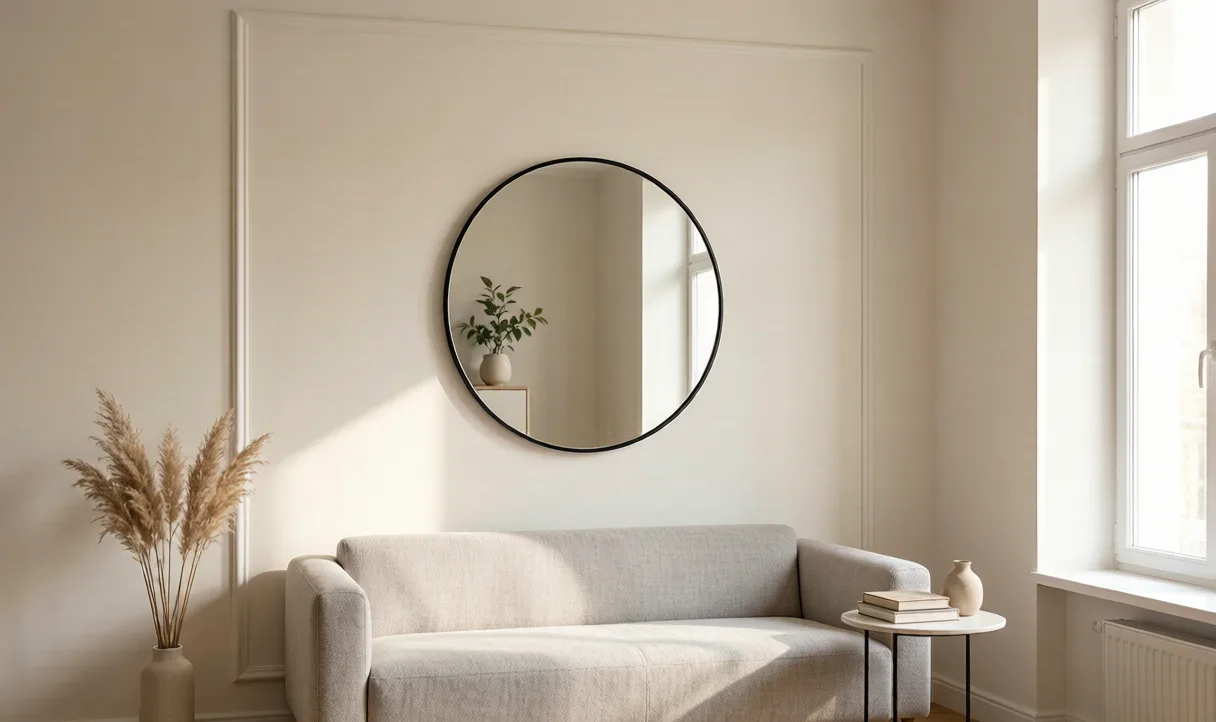

A client called me about a studio where every wall had a mirror. “It was supposed to make it feel bigger,” she said, “but I feel watched in my own place.” She’d mirrored the closet, the hallway end, and the wall opposite the bed. The room looked larger and felt like a waiting room, all shine and no rest.
Too many mirrors feng shui comes down to one plain point. A mirror bounces energy instead of letting it rest. One or two lift a dark corner; stack them on every wall and the room stops holding still, light scatters, and your own reflection meets you from three angles so the eye never lands. I see this most in new builds where the designer tripled the mirrors to sell the square footage, and the tenants call me a month later asking why they can’t relax at home.
Fix 1: Move the Bedroom Mirror Out of Sight
The bedroom is the real test. A mirror opposite the bed keeps the room visually active while you sleep, which is the last thing a bedroom needs. I tell clients to move bedroom mirrors to a closet door you can close, so the surface isn’t working while you’re in bed. In a flat I did exactly that and the client said the room finally went quiet at night. If the mirror is built into the closet door, a curtain or a slide panel over it does the same job. The reason a mirror by the bed bites at night is simple: any movement in the glass, even your own, reads as someone else in the room. The brain knows it is you, but the body’s startle response does not care about logic at 3 a.m. Cover it and the room goes still. You do not need to understand the theory to sleep better, you just need the surface dark.
Fix 2: Stop Mirrors From Facing Each Other
Two mirrors pointed at each other throw light and reflection back and forth, and the room reads as a hallway with no end. Break the pair. Keep one and angle the other, or cover one with a cloth. This is the fastest way to calm a space that feels like it’s humming. If you love both mirrors, hang one higher than the other so they do not meet at eye level, or turn one to catch a wall instead of the glass across the room. You are not banning shine, you are stopping the endless bounce.
Fix 3: Keep One Statement Mirror Per Room
You don’t need to throw anything out. One good mirror per room is plenty. It lifts a dark corner, fakes square footage, and gives the eye a single place to land. A studio tenant kept only the closet mirror and said the place felt twice as calm. The rest of the surfaces stay matte and quiet.
Fix 4: Watch the Hall and the Front Door
Avoid a mirror at the end of a hall pointing at the front door. It bounces every arrival straight back out, so the entry never settles. A mirror beside the door is fine; a mirror that catches the door in its face is not. I’d rather see one good mirror than a hall of them.
Fix 5: Do the Weekend Test
One simple check is to take them all down for a weekend and see which you actually miss. Most people rediscover one or two they love and three they’d forgotten were there. The ones you miss go back; the rest stay in the closet. Store the extras leaned against an interior wall in a closet, not propped where you will see them. Out of sight is out of the room’s energy, which is the whole point. If you cannot bear to part, a garage or a storage bin keeps them from quietly re entering the space. This saves you from guessing and from throwing away something you’ll want later.
Where Mirrors Earn Their Keep
Not every mirror is a problem. A north-facing room that never sees sun benefits from one mirror placed to borrow light from the door, because
the bounce is doing real work, not just decoration. Bathroom mirrors are fine, even welcome, since a bathroom is already a room of water and movement and a single mirror there reads as normal, not noisy. The trouble starts when the same room collects two or three. An entry mirror that lets you check your look on the way out is doing honest work, and a mirror in a dark hallway that borrows light from a room beyond earns its place. The test is whether the bounce has a job. A mirror with a purpose is calm; a mirror with nothing to do is the one that hums.
Size matters too. A tall mirror in a low-ceiling room exaggerates the height and can feel like the wall is leaning in, while a wide mirror in a narrow room makes the squeeze worse. I’d sooner see a small, well-placed mirror than a floor-to-ceiling sheet. The goal is one surface the eye can land on, not a wall that throws it back.
Do You Need to Worry?
The space isn’t cursed, it’s just jittery, and pulling back a few surfaces fixes most of it. A room should calm you down, not multiply you. If the rest of the home is lit and uncluttered, the mirrors are the one thread pulling tight, and the fixes above untie it. Children’s rooms in particular do better with one small mirror or none, since a kid already has enough motion without their own reflection bouncing back from two walls. The same goes for a home office where you do focus work. A mirror behind you on video calls throws light and motion into your peripheral view and frays concentration the way a window behind the desk does. One small mirror for a quick check is fine; a wall of them turns the work corner restless. Match the mirror count to how still you want the room to feel.
A Renter’s Mirror Wall
A renter I read had inherited a bedroom with a mirrored wall behind the headboard, glued on, no way to remove it. We hung a linen curtain on a ceiling track that closed the whole wall at night and opened by day, and she put a small lamp on the nightstand so the eye had a warm thing to land on instead of glass. Renters cannot undo what a previous tenant installed, but a track and a panel cost little and come down on move out. The wall stopped working while she slept, which was the only thing that mattered.
When More Mirrors Are Fine
More than one mirror is not a sin in the right room. A dressing area with a full length mirror and a smaller one for the face is normal, because that corner is built for reflection and you are not trying to rest there. An entry can carry two if they do not face each other. The trouble is reflection in the rooms where you want to settle, the bedroom, the reading nook, the dinner table. Put the shine where you move, keep it matte where you rest, and the count stops mattering.
The Mirror Audit, Step by Step
Walk the home with a notebook and list every reflective face, mirror, glass cabinet, shiny tile, even a glossy backsplash. Mark the ones you see from the bed, the table, or the sofa. Those are the first to go or cover. Then run the weekend test on the rest. Most homes that feel jittery have
three or four surfaces doing the same job one would do, and pulling two of them drops the noise fast. You will know you are done when the room feels quieter than it looks.
I’m the founder of Fengshui Power, trained in the Zhengyi Dao lineage and the Yang Gong school. I serve clients remotely, from anywhere, through online BaZi readings and feng shui consultations done from your birth date and floor plan. More about my background. When you want the personal read, a consultation is how we begin.
Common Questions
Is it bad to have too many mirrors?
It isn’t cursed, it’s jittery. Stacked mirrors bounce energy so the room never rests and your reflection meets you from every angle. Pull back to one per room and the space settles.
Where should I not put a mirror?
Avoid a mirror opposite the bed and one at the end of a hall pointing at the front door. Both keep energy and the eye moving when they should settle. A mirror beside the door is fine.
How many mirrors per room is enough?
One statement mirror per room is plenty. Remove mirrors that face each other and keep the rest of the surfaces calm and matte. The weekend test
shows you which ones you’ll miss.
Can mirrors help a small apartment?
Yes, used sparingly. One or two lift a dark corner and fake square footage, but stop there or the space turns restless. A studio with mirrors on every wall feels larger and worse to live in.
Should I cover a mirrored closet door?
If it faces the bed, yes. A curtain or slide panel over it stops the surface from working while you sleep, and it’s reversible. Built-in mirrored doors are the most common bedroom mirror problem I’m called to fix.


