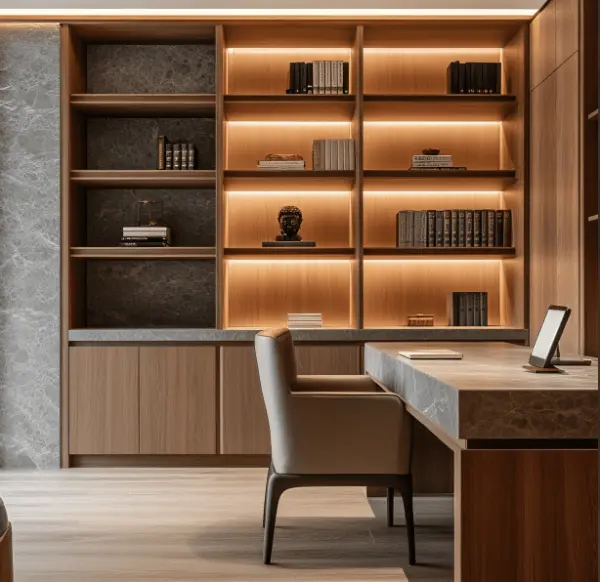

Let me tell you about a client. He ran a small design business from a spare bedroom and told me he could never settle into the work. Every morning he sat down, and within an hour he was pacing, checking the fridge, answering messages he did not need to answer. I asked one question: where does your back point when you sit at the desk? He turned his chair and showed me — straight at the room’s only window, with the door behind him and to the side, so every time someone walked past the hall he half-turned. We turned the desk to face the room with a solid wall at his back, added a small lamp, and moved the dead plant. Two weeks later he said the work “finally had a floor under it.” Same desk. The seat had been the problem, not the man.
I start there because office feng shui is less about luck and more about whether a space lets you think. The bedroom is a yin room, built for rest. The office has the opposite job: it needs to hold focus without draining you. Get it right and the work flows. Get it wrong and you feel busy all day and finished nothing.
This is the long version. It moves through the room the way I do in a consult, from the desk outward, and each section points to a deeper read on that subtopic.
In this guide
- What office feng shui actually changes (and what it doesn’t)
- The desk in command position
- A wall behind you, or a stand-in
- The window and the beam
- Light and color that hold the day
- Plants that pull the room awake
- Clear surfaces and a few objects with intent
- The career corner, used with intention
- Air you can feel
- Shut it down at night
- When the office is a corner of another room
- When the rule can bend
- Common questions
- About the author
- Continue reading: cluster pages
What office feng shui actually changes (and what it doesn’t)
Most of the anxiety around this topic comes from people expecting it to do something it can’t. Office feng shui is the practice of arranging the workspace so your attention settles and your day feels under your control. That is the whole of it. It is not a charm that raises your income, not a cure for a difficult boss, and not a replacement for actually doing the work.
What it does well is concrete. It turns the desk so your back is supported and the door is in view. It adds light so the room doesn’t close in by mid-afternoon. It clears the surface so your eye lands on the task, not the mess. None of this writes the report for you. All of it changes how the room feels when you sit down, and that feeling is the part worth having.
If you are skeptical, that is reasonable. A workspace quietly rewards what is ordered and quietly punishes what is scattered, and that holds whether or not you ever use the word qi. The rest of this guide is about the ordered and the scattered, with as little folklore as I can manage.
The desk in command position
The desk is the anchor of the office, so it gets the same principle the bed, the sofa, and the stove get: command position. The person working has a clear view of the door, the room in front of them, and something solid at their back, and is not lined up directly in the doorway’s path. You can see who comes in without sitting with your back to the room.
A solid wall behind the desk is what practitioners call mountain at your back — support you feel in your body. The person working is not braced for whoever walks in, not glancing over a shoulder every few minutes. Even clients who roll their eyes at the concept report the same thing once it is done: the work gets steadier.
Three smaller points ride along:
- Avoid the desk directly facing the door. Sitting in the doorway’s line means every arrival hits you head-on. Angle the desk a quarter turn, or put a console or a plant between you and the door.
- Keep the path around it open. A desk you have to step over to reach the window turns the room into an obstacle course. Keep at least three feet of clear walking room.
- Face the work inward, toward the room. A desk pinned to a wall with your nose to the paint leaves you facing a dead end through the whole task. Turn it so the room is in front of you.
When the room gives you a beam, a window behind, or no free wall, the desk placement guide walks through each case with a photo and a one-week test.
A wall behind you, or a stand-in
Rentals and open-plan homes love a desk stranded in the middle of the floor. No wall behind it, nothing at its back, the person working exposed on three sides. This is the single most common office complaint I hear, and the fix is almost always a virtual wall rather than a move you cannot make.
Three stand-ins work, alone or together:
- A tall cabinet or bookshelf behind the chair. Even a low one gives the eye something solid at the back. Put a lamp and a plant on it and the seat stops feeling adrift.
- A heavy curtain or a tall plant. A fiddle leaf fig or a bamboo palm in a floor pot works like a soft wall and adds life to the corner.
- A console table behind the desk. Closed storage doubles as backing and hides the cables.
The point is not the object. The point is that the person working no longer feels like the back of the room is open and watching. One client with a studio apartment built a virtual wall from a bookshelf and said she finally “stopped bracing for the door” even though the desk was nowhere near the entrance. The office and the focus are connected more than people expect.
The window and the beam
A window behind your chair is the second most common restless-work setup I see. Glass is a thin boundary, and the street, the yard, or the hallway behind it pulls your eye outward every few minutes. The fix is to move the desk so the window sits to the side, or to draw a sheer curtain so the light helps without the distraction.
A window in front of you is less of a problem than one behind, but a bright one still frays concentration by pulling the eyes outward. Put it to the side, or half-close a blind, so the light works for you instead of against you.
A beam crossing your chair presses on the exact spot where you make decisions. More than one client has told me about headaches they couldn’t explain until we moved the chair a foot. You can’t always shift the desk, but a soft ceiling cover, a fabric panel, or a one-foot nudge usually gets the beam off your head. The overhead-beam guide covers the reversible fixes for renters.
Light and color that hold the day
Color sets the room’s temperature. Soft warm tones — beige, a light yellow, a muted sage, a warm white — keep the nervous system settled through a long day. A deep charcoal or a stark clinical white does the opposite: one closes the room in, the other reads like a hospital hallway and keeps people on edge.
The five elements give a loose map. Wood is green and brown, growth. Fire is red and orange, warmth. Earth is yellow and beige, steadiness. Metal is white and grey, clarity. Water is blue and black, stillness. Notice which energy the room is missing, then add a little.
For most offices, the safest base is warm and light: soft beige, warm white, a muted green, a dusty blue. Use red and orange as accents, not walls, unless the room is large. The one move that saves regret is to paint one wall and live with it a week before committing to the whole room. The color you stop noticing is the one doing its job.
Light matters as much as color. Natural light wins when you have it. When it’s missing, warm-toned bulbs beat cold white. Layer it: an overhead fixture for tasks, a lamp on the desk, a softer light for the end of the day. The colors guide goes room by room, including the warm-beige-versus-grey-beige trap.
Plants that pull the room awake
A living plant is the cheapest energy fix in an office. A money tree, a pothos, or a lucky bamboo in the corner brings the space to life and cleans the air while it’s at it. A dying plant does the opposite. I had one client keep a brown pothos “for luck” for two years. Toss it. A plant halfway gone drains the room more than no plant at all.
A few rules:
- Skip the cactus and anything spiky near your chair. They belong outside, not where you sit and think.
- One or two modest plants is plenty. A shelf of twenty pots turns greenery into a greenhouse you can’t keep up with.
- Match the plant to the light you actually have. A plant that dies in a dark corner looks like neglect you chose.
The plants guide covers the species worth keeping and where to put a trailing vine.
Clear surfaces and a few objects with intent
Clutter is the most common office problem and the easiest to ignore. A desk buried in old printouts and dead cables splits your focus every time you look up. Keep only what the current task needs and store the rest. A tidy surface in your direct line is the cheapest focus tool there is, and it isn’t a personality trait. It’s a daily reset. Fifteen minutes on Friday clears the week’s drift before it piles up.
Some objects earn their place as reminders of intention — a small dish of meaningful things, a photo that makes you smile, a single object that signals why the work matters. These work because you put thought into the space, not because the object itself changes anything. Broken things work against you: a cracked mug, a snapped pen cup, a print with a torn corner, they all read as “unfinished” every time you glance over. Remove them. Keep sharp or aggressive decor out of your sightline. The point is intention, not accumulation.
The career corner, used with intention
Some schools point to the north or northwest as career-linked sectors. The useful version of that idea is plain: keep that corner tidy and actually useful, because an empty “lucky” corner does nothing. Put the things you work with there and keep them ordered, instead of dropping a statue in an empty space and calling it done. The corner only earns its keep if it holds work you care about. If it’s where the printer and a pile of returns live, it reads as storage, not career. The corner supports the work. It does not replace it. The career guide explains why I’m wary of treating any corner as a shortcut.
Air you can feel
Stale air is the quiet killer of afternoon focus. Open a window when you can. When you can’t, an air purifier or even a five-minute door-open break resets the room. Dust collects on the dead zones — the top of the monitor, the plant leaves, the floor under the desk — and that film reads as stuck energy. A clean office isn’t about looks. It’s about whether the space feels alive when you walk in, and most people feel it before they can name it.
Shut it down at night
One fix most people skip: close the laptop and clear the chair when the workday ends. A workspace that stays “on” never lets the room recover, and if your bedroom is next door, a lit screen in a live desk keeps the mind in work mode long after you meant to be off. Make a small close-down ritual. Lid down, chair tucked, light off. The room becomes a room again instead of an office that never clocks out, and your sleep pays for the difference.
When the office is a corner of another room
If your home office is a corner of the living room or the bedroom, the same rules hold, just tighter. Use a rug or a low shelf to mark the work zone so the room knows when you’re working and when you’re not. A defined edge lets the space switch off at night even without a door. A rolling clothes rack with a long curtain, or a tall plant on a stand, does the same job and leaves with you when the lease ends. The edge is what counts, not the material.
When the rule can bend
None of this is a law, and I’d rather you not treat it like one. If the only spot with decent light puts your back to the room, take it and build the side sightline where you can, because a space you actually use beats a perfect layout you avoid. The desk that faces a blank wall but gets morning sun will serve you better than a correct corner you dread sitting in. Renters can’t repaint or move walls, but desk position, a healthy plant, warm light, and a cleared surface are all reversible and free. The renters guide covers the no-drill version of every fix here.
Use the rules to fix what bugs you, not to invent problems. The moment the setup stops fighting your day, you’re done.
Common questions
Which direction should my desk face?
Face the door with a solid wall behind you. If your layout forces a choice, take the wall-backed seat and use a mirror or an open door to keep the entrance in view. The goal is command of the room, not a specific compass point.
Is a window behind the desk a problem?
It can be. A window behind you pulls the eyes outward every few minutes and frays concentration. Put it to the side, or half-close a blind, so the light helps instead of distracting. A sheer curtain cuts glare and keeps the calm.
What color works best for a home office?
Pick soft, warm tones — beige, light yellow, muted sage, warm white. They hold the room calm through long hours, and harsh or dark colors make the space feel tense. Warm-toned bulbs stand in when natural light is missing.
Which plants are good for an office?
Try a money tree, pothos, or lucky bamboo toward a bright corner of the room. They lift the space and clean the air. Keep cactus and anything spiky away from your chair, and toss a plant that’s more than half gone.
Does the north or northwest corner help career?
Some schools link those sectors to career. The practical move is to keep the corner tidy and filled with things you actually use for work. An empty “lucky” corner does nothing, and the corner supports your work, it doesn’t replace it.
Should I clear my desk every night?
At least the front zone and the chair. A workspace that stays switched on never lets the room recover, and your sleep pays for it. A two-minute close-down — lid down, chair tucked, light off — is enough.
Can renters improve office feng shui?
Yes. Setting the desk in a commanding spot, adding a living plant, warm light, and a clear surface costs nothing and comes down when you leave. The whole practice fits a rental.
About the author
Sanhe (also known as Guo Yutong) is the founder of Fengshuipower. Trained in classical feng shui, she works with clients worldwide through online consultation reports, reading floor plans, photos, and BaZi charts from anywhere. Her approach borrows the rigor of the old texts and leaves the folklore at the door. She writes the practical guides on this site.
If you want a practitioner to read your specific office, a Fengshuipower consultation walks through your layout, your desk, your door, your window, and the rest of the plan, in that order, and ends with a written plan you can act on.
Continue reading: cluster pages
This pillar links out to deeper reads on each subtopic. Each one goes further on a single point, and each one links back here. Read the one that matches the issue your office has, not all of them.

It抯 actually a nice and helpful piece of info. I抦 satisfied that you just shared this useful info with us. Please keep us up to date like this. Thanks for sharing.
Thank you so much for your support and kind words! 😊
We’ll continue to share more practical insights on Feng Shui and Chinese zodiac guidance to help you make better decisions in life. Feel free to keep following along and leave a comment anytime if you have questions or thoughts!
Keep working ,remarkable job!
I appreciate, result in I found exactly what I was having a look for. You have ended my four day long hunt! God Bless you man. Have a nice day. Bye
I’m glad I could help you! Feel free to check back often for my latest updates, and you can also share them with your friends — they might find it helpful too.
If you’re a beginner, you can find a professional to help you get started.
Excellent post. I was checking constantly this blog and I am inspired! Extremely useful information specifically the remaining part 🙂 I maintain such information much. I used to be looking for this particular info for a very long time. Thank you and best of luck.
Thank you so much for letting me know about this issue! I will improve it gradually. You’re always welcome to visit!
Hello! Do you use Twitter? I’d like to follow you if that would be okay. I’m undoubtedly enjoying your blog and look forward to new posts.
Hello, thank you for your liking. I haven’t used my account in a long time, but your reminder made me want to update it. This is my Twitter: @bais9191. The profile picture is a Tai Chi symbol.
I have been browsing online greater than three hours lately, yet I by no means discovered any fascinating article like yours. It is beautiful worth enough for me. In my view, if all webmasters and bloggers made excellent content as you probably did, the internet might be much more useful than ever before.
whoah this blog is excellent i love reading your articles. Keep up the great work! You know, lots of people are looking around for this info, you can help them greatly.
Hey very nice site!! Man .. Excellent .. Amazing .. I will bookmark your I’m happy to find a lot of useful info here in the post, we need develop more strategies in this regard, thanks for sharing. . . . . .
I think that is among the so much significant info for me. And i’m happy reading your article. However want to observation on few common things, The website style is wonderful, the articles is actually great : D. Excellent job, cheers
I抳e learn some good stuff here. Definitely price bookmarking for revisiting. I surprise how so much attempt you place to create this kind of fantastic informative web site.
Youre so cool! I dont suppose Ive learn anything like this before. So nice to find somebody with some original thoughts on this subject. realy thank you for beginning this up. this website is one thing that is wanted on the internet, somebody with a bit of originality. helpful job for bringing one thing new to the internet!