
How to Resolve the Feng Shui Issue of a Front Door Facing a Hallway
Many residential buildings are designed so that multiple households share the same floor. The unit located deepest inside often requires walking down a long corridor to reach the front door. In this particular layout, the front door faces directly down the hallway. In Feng Shui, such a setup creates what is known as “Sha Qi” (piercing or harmful energy).
When a residence is situated at the end of a corridor and the front door opens directly toward it, airflow rushes straight into the home. In Feng Shui, this intense, straight-line energy is referred to as “Sha Qi” or “Piercing Sha,” and is often likened to an invisible arrow.
This aggressive energy may lead to emotional instability for residents, tension among family members, and can even negatively impact health and fortune. In both homes and workplaces, prolonged exposure to this kind of energy can result in poor communication, frequent arguments, or setbacks in one’s career.
Solution: Use Screens, Partitions, or Plants as a Barrier
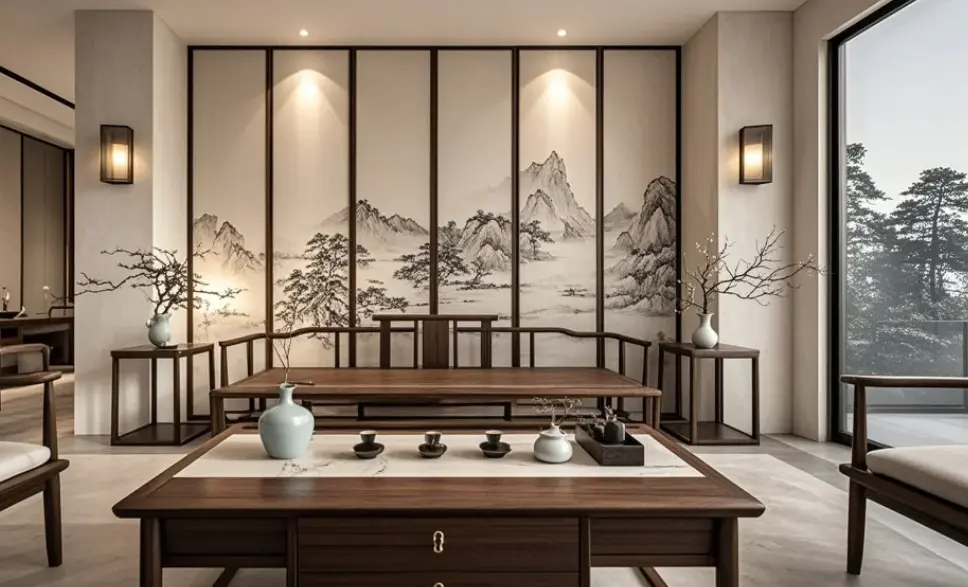
A practical way to counteract this Feng Shui problem is to place a screen or partition just inside the entrance. These barriers help block the straight-line flow of energy and soften the intensity of Sha Qi before it enters the living space.
In addition to traditional screens, options such as console tables, wooden dividers, tall indoor plants, or even a small entryway wall (foyer) can serve the same purpose. These features not only reduce negative energy but also enhance the overall aesthetic of your home.
Another Feng Shui Problem: A Hallway That Splits the Entire Home
Another unfavorable Feng Shui layout is when a hallway runs through the center of the home, directly aligned with the main entrance, effectively splitting the space into two halves. In Feng Shui, this is known as the “Black Butterfly” layout, symbolizing division.
Such a layout disrupts the natural flow of energy and prevents the home from “gathering and retaining Qi” (vital life force). As a result, it may lead to emotional distance between family members, ongoing conflicts, or even serious issues such as separation or divorce.
How to Adjust the Layout and Restore Balance
If your home has this kind of through-hallway layout, you can improve the Feng Shui with the following strategies:
Add a screen, decorative shelf, or hanging divider in the hallway to visually and energetically break the line of separation.
Use mirrors, lighting, and color schemes to unify both sides of the home and promote harmony.
Create shared spaces such as cozy reading nooks or dining areas to encourage interaction and connection among household members.
Like this article? At FengShuiPower, we continuously share practical tips on home Feng Shui, office Feng Shui, Feng Shui layouts, Five Elements balancing, Feng Shui techniques, Xuan Kong Flying Stars, and Chinese zodiac fortunes/annual forecasts. We also offer auspicious Feng Shui items (such as Pi Xiu, Five Emperor Coins, and Money Trees), along with professional Feng Shui consultation services and practical Feng Shui courses.
We help you enhance health, attract wealth, and improve relationships through simple arrangements. Want personalized advice or to explore related topics, Keep browsing for more content, and feel free to leave us a message with your questions.


