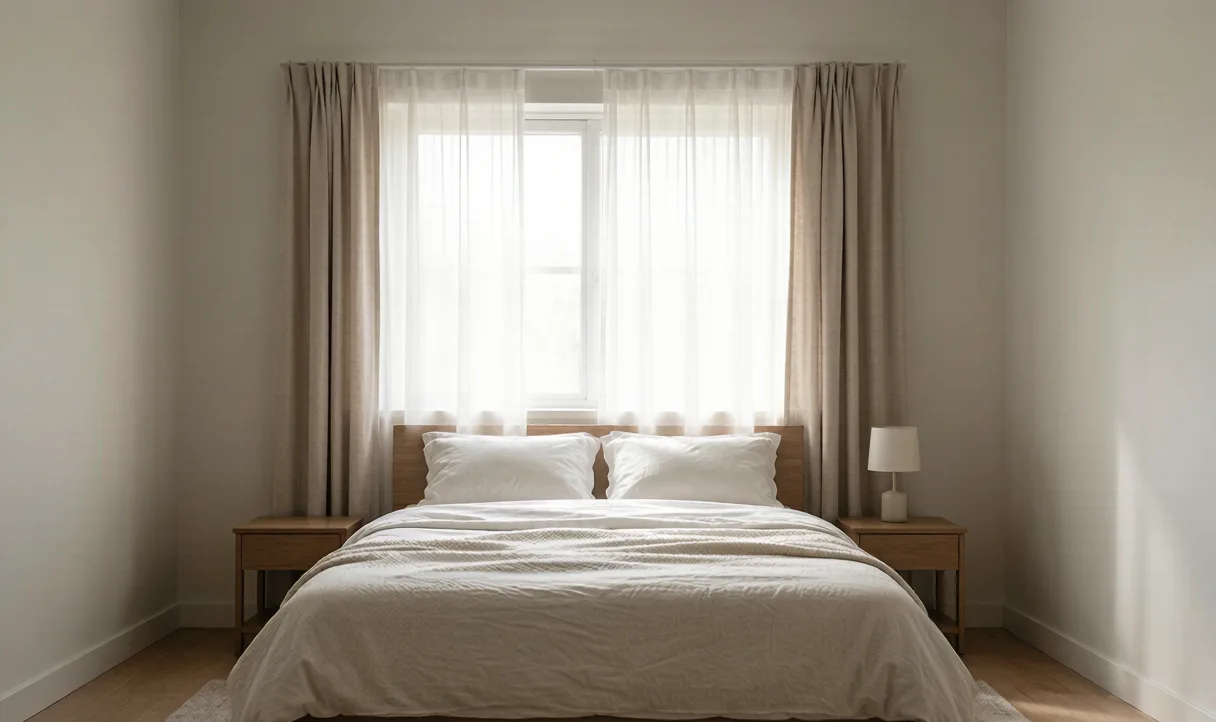

A client opened the door to her compact apartment and pointed straight at the bed. It sat pushed under the only window because the room left her no other choice. “Is this ruining my sleep?” she asked. She had read three forums and each one scared her more.
Bed under window feng shui is less about fate and more about a draft, a streetlight, and a back with nothing solid behind it. The short answer: a bed beneath a window is fine to sleep in once you block the opening at night and give your back something to lean on. You don’t need to rebuild the room.
Why Bed Under Window Feng Shui Worries People
The classical reason is easy to feel even if you don’t buy the theory. A window is an opening. When your bed sits directly beneath it, your back is exposed to air, light, and noise from outside, and your head points at glass instead of a wall. None of that is mystical. A cold draft on the shoulders, a streetlamp bleeding through the blinds, or a 6 a.m. sun on your face genuinely fragments sleep. The body stays mildly alert when it can’t feel a wall at its back, the same way you sleep lighter on a train than in a bedroom.
There is a plainer way to say this that I use with every client. In the layout we call the commanding position, you want your bed where you can see the door while your back rests against a solid wall. The window breaks the “back against solid” half of that. You don’t have to care about the name. You just want to fall asleep without a breeze on your neck and wake without light in your eyes.
I have seen the same setup in a lane house outside and a flat. The fix was the same every time: close the glass, back the bed, and sleep improved within a week. People feel the change before they can name it.
The reason this shows up in sleep trackers is not magic. When the back has nothing solid, the nervous system keeps a faint guard up, the same low hum you feel with your back to a crowded cafe. Give it a wall or a headboard and that hum drops. Clients tell me they wake less and
remember fewer dreams, which is just the body spending more of the night in deep sleep. You can run the test yourself before you spend a cent.
The Fixes, in Order
1. Close the glass at night. Hang a heavier curtain and draw it before you sleep. A double layer helps: a blackout curtain behind a softer decorative one. The window stops reading as open, and the room reads as enclosed. This alone answers most of the worry for clients who can’t move the bed.
2. Put a real headboard against the window wall. A solid headboard returns the sense of backing your spine wants. Make it tall enough to cover the lower part of the window if you can. Upholstered ones work best because they also damp sound. The headboard does the practical job and the reassuring job at once: your back has something to lean on.
3. Keep the sill clear. A low plant or a small lamp on the windowsill softens the edge and gives the eye a reason to land somewhere other than glass. Avoid a mirror behind the bed. It multiplies the sense of exposure and bounces light during the night.
4. Anchor with a rug and a lamp. A small rug under the bed and a low lamp on the nightstand tell the room this is a sleeping zone, not a window seat. The space feels claimed.
5. Renters, use a tension rod. You can’t drill the wall, but a tension rod with a heavy curtain costs little and comes down when you leave. The bed itself isn’t a curse, just a draft you can manage.
Pick curtain color with care. A bright white curtain still lets the room feel open by day but glows at dawn, pulling you awake early. A warm neutral or a muted tone holds the dark better and reads as a wall after sunset. The fabric weight matters more than the pattern, so choose density over decoration.
When It Is Actually a Problem
Skip the cures if the cause is structural. A window that leaks, rattles, or sits above a busy road is a comfort problem first, and a curtain won’t fix a real draft. Seal the window, then handle the layout.
If the window is the only source of daylight in the room, don’t black it out completely by day. Open the curtain in the morning so the room breathes, then close it at night. The goal is a window that behaves like a wall after dark, not a room that lives in permanent gloom.
A high window, chest height or higher, bothers people far less than a low one you feel at shoulder level. If your only option is a low window, the headboard-plus-curtain combo matters even more. I have had clients sleep soundly for years with the bed under a high transom window simply because the glass sat above where their body rested.
A Renter’s Version
A renter I worked with had the bed under a window and a landlord who would not allow a single screw. We skipped the headboard drill and used a tall upholstered panel that leaned against the wall and stayed put under
its own weight. A tension rod carried a blackout curtain, and a strip of weather foam along the sill cut the draft she had blamed on the layout. Three weeks later she said the room felt like a room. None of it needed permission, and all of it came down when she left. That is the whole point: the bed is not the problem, the open glass is, and glass answers to a curtain.
When You Can Ease Off
You do not have to treat every window bed like an emergency. If the window is small, set high, and faces a quiet side of the building, the draft and light may never reach you, and a plain blind is enough. The rule exists because openings disturb sleep, not because a window is a curse. I tell clients to run the one week test: sleep as you are, then add the curtain and headboard, and keep only what changes how you feel. Plenty of people keep a low plant and a light blind and sleep fine. Spend your effort where your body tells you to, not where a forum says you must.
If You Can Move the Bed
When the room gives you a choice, take the wall opposite the door or diagonal to it, with your head to a solid wall and your eyes on the entrance. That is the layout most people settle into fastest. Avoid a bed that shares a wall with a toilet or a loud appliance on the other side, and avoid a beam running directly over your chest, because both read as pressure even when the room looks fine.
The window wall is the last choice, not a forbidden one. I tell clients to rank their walls: solid wall with a view of the door is best, solid wall without the door is fine, and the window wall is simply the one that needs the curtain and headboard treatment above.
Children’s beds follow the same rule. A kid under a low window tends to wake at first light, and a blackout curtain plus a headboard helps them too. The fix is the same at any age.
One more thing on the move: if the only better wall shares a wall with the kitchen, the fridge and pipes on the other side can hum through the night. A solid wall is good, but a quiet one is better. Listen to the wall before you commit to it, especially in older buildings where the plumbing runs loud.
I’m the founder of Fengshui Power, trained under the Zhengyi Dao lineage. These days I take clients entirely online: I review your BaZi chart and your home’s layout over a call or from the photos you send, then give you a step-by-step plan. My about page covers my background, and a consultation is the way in.
Common Questions
Is a bed under a window bad luck?
No. The concern is practical: drafts, light, and noise break sleep, and a back with no wall behind it keeps the body alert. Block the window at night and the problem mostly goes away.
How do I fix a bed under a window?
Draw a heavy curtain at night, add a headboard against the window wall, and keep the sill clear. That gives your back support and closes the opening without moving the bed.
Can a headboard solve bed under window feng shui?
Often yes. A solid headboard against the window wall returns the sense of backing, and a thick blind turns the glass into a wall. The fix is physical, not symbolic.
Should I move the bed if I can?
If the room allows a better wall with your head to solid backing and eyes on the door, take it. If not, the curtain and headboard approach works, and you keep the layout you have.
Does a high window above the bed matter less?
It usually bothers people less because the glass sits above where the body rests, so the draft and light hit lower than your head. The curtain and headboard still help, but the effect is milder.
